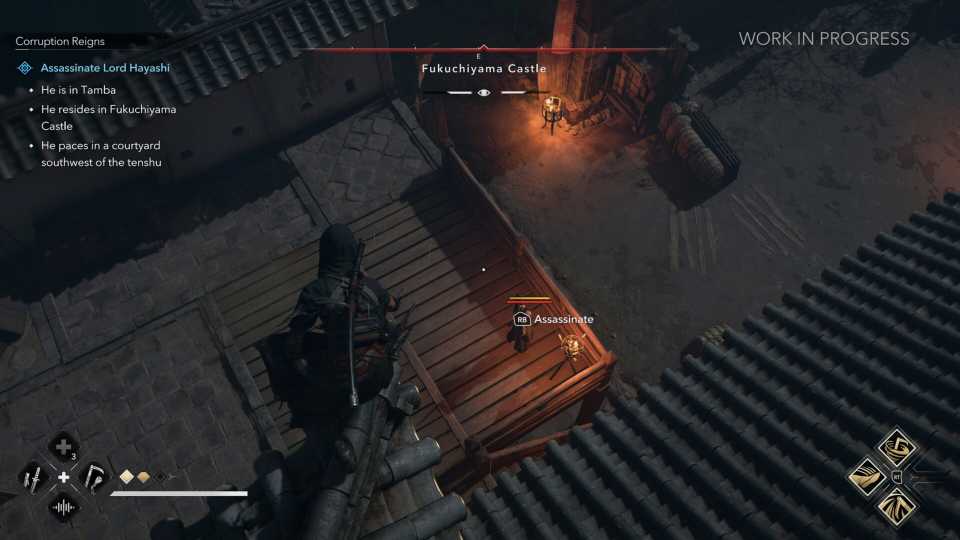
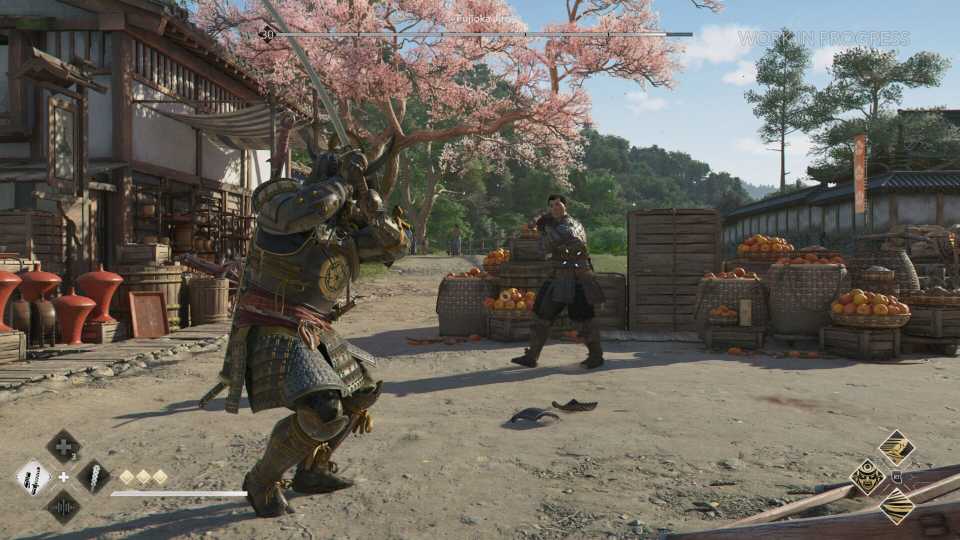
Throughout the series, the Assassin's Creed franchise has brought players to a wide range of historical eras: Ancient Egypt, Revolution-era America, Renaissance Italy, and many more. Now, in Assassin's Creed Shadows, players journey to Japan at the end of the tumultuous Sengoku period. While developing Assassin's Creed Shadows, the Ubisoft Quebec team researched key historical figures, weapons, traps, architecture, customs, and more.
The Best War Games spoke to members of the Assassin's Creed Shadows development team, including creative director Jonathan Dumont, art director Thierry Dansereau, and associate game director Simon Lemay-Comtois, about their research process. The team discussed how they chose which weapons Yasuke and Naoe would wield, their interpretations of key Sengoku-era figures such as Oda Nobunaga and Hattori Hanzo, the fun and challenging elements of castle design, and more. This transcript has been edited for clarity and brevity.

Assassin's Creed Shadows Reveals Progression Details
Ubisoft releases a look into Assassin's Creed Shadows' progression systems.
Meticulous Historical Research Went Into Creating AC Shadows' Japan
Q: Can you discuss the historical research performed for Assassin's Creed Shadows in general? What was the approach to nailing both big and small details?
Dumont: As with any Assassin's Creed game, it is always a long, humbling, learning process to start the recreation of a game like Assassin's Creed Shadows. The historical research for Assassin's Creed Shadows began early in the game's conception. [We] integrated internal historians and specialists into the team. Additionally, we collaborated with external time period specialists and historians from Japan and around the world to ensure a comprehensive understanding of the era.
A significant part of the research involved creating a vast data bank from various source materials and information. This data bank was continuously updated, helping the team learn and guide their craft in developing the game world. This meticulous process covered everything from architecture and gestures to clothing, prop details, and character development to name a few.
To further refine their vision, a part of the team embarked on a scouting trip to Japan. This firsthand experience provided invaluable insights that enhanced the game's credibility. While the game is a grounded representation of feudal Japan, Assassin’s Creed Shadows is ultimately a work of fiction. Therefore, some creative choices were made to enhance the gameplay and narrative experience.

Assassin's Creed Mirage Historian Reveals Funny Detail About Soap
Assassin's Creed Mirage is filled with historical elements, but one small, funny detail about soap may just about take the cake.
Q: What was the “oddest” thing you’ve learned working with historians and consultants? I still think about Assassin’s Creed Mirage’s soap all the time.
Dumont: I don’t think there was anything odd as you have to open up to what the setting and culture was and try to understand it. But sometimes, I really feel for our group of experts and historians, because the creative teams will have specific questions that can send the researchers very perplexed. For example, we wanted to stage noh theater in the game and the animation and audio teams wondered if the spectators applauded during or after the play. Seemed like an easy question at first, but everybody was trying to find the answer, which was much more complex. Well, it turned out it was introduced in the 19th century, so there was no clapping, which is not odd per se, but challenged the research teams quite a bit.
Q: What went into the research and design process for the specific parts of Japan shown in Shadows? Could you cite any specific examples?
Dansereau: We always do a lot of research when making an Assassin’s Creed game. We traveled to Japan and conducted a field trip with experts and historians; we used museum data and many other references to gather as much information as possible about the game’s setting and locations.
Thanks to our field trip and the research conducted during the production, the learning gathered was used to build the game's locations. For example, being able to be on site and visit the many castles really helped us to understand their size, the way they were made, the materials used, and how they aged through time. Also, having a better understanding of Japanese feudal time urbanism-type layouts helped us a lot to create a credible interpretation of feudal Japan.

Assassin's Creed Shadows Confirms Steam Feature
The newest Assassin's Creed game will launch with a popular Steam feature straight out of the gate, giving fans more to look forward to on release.
Developing Weapons, Including Historical Figures, And Designing Castles
Q: What was the development process behind the inclusion of period-accurate weapons? Could you discuss the research and any capture techniques used for these?
Lemay-Comtois: Narrowing down a shortlist of weapons from Japan’s Sengoku period was much harder than we thought - because there are so many cool weapons to choose from! The katana was locked-in from the start, as it is the most emblematic weapon of the period, with the teppo rifle coming as a close second, showcasing the mechanical revolution of the period that accounts for a part of Nobunaga’s successes. Naoe’s kusarigama was also an early lock, if for no other reason than to allow our talented fight team maximum development time to figure out how to make it work! Much of the credit goes to our stuntmen and women on the Mocap stage, who are all trained in Japanese weapon handling. They would always help us adjust, tweak and stylize our combat mechanics while staying grounded in the storied Japanese martial arts.
Q: Nobunaga is a towering figure in Japanese history and has seen countless depictions. How did you approach recreating Nobunaga for Assassin's Creed Shadows?
Dumont: With Oda Nobunaga being such an important figure in Japanese history, we wanted to depict the complexity and nuances of his personality and actions. Seeing on one side the brutality of his conquest through the eyes of Naoe during the invasion of Iga was important to see the effects of war and his effectiveness as a military leader. On the other side, [players see] more of a private side of his personality through Yasuke’s perspective as someone who was an outside-the-box thinker, promoted meritocracy, [patronized] arts and valued relationships. We start with facts and historical events and move him into our historical fiction.

Q: Likewise, could you talk about the research for Hattori Hanzo? How important of a figure is he in-game?
Dumont: There is less documentation on Hattori Hanzo, and a little bit more mystery around his actions. Still, we try to ground his story in historical events and then develop his character in our fiction. He was a very interesting character to weave into our storylines and plays a good role in our game, but I can’t talk about it.
Q: Were there any difficulties or particularly fun moments when accurately recreating some of Japan's famous and historic castles?
Lemay-Comtois: The most interesting fact about Japanese castles of the period is that many of them were quite literally - for lack of a better term - “level-designed” to mislead would-be invaders, with natural choke points and dead-ends where archers could rain down fury on troops below. This also applied to lone attackers too, with the use of hidden chambers where samurai could hide in wait in case a particular audience went south, as well as the use of nightingale floors – a purpose-built creaking floor that would alert anyone within earshot if an unwanted presence was moving closer.
The single biggest challenge for us then, was to build our castles to offer enough clarity to help guide players in the maze-like architecture that is so emblematic of the period.
Q: This game has some amazing sets, with destructible environments and indoor action sequences featuring things like nightingale floors. Are there any particular Japanese films, TV shows, novels, or other media that you used in your research process? Did you draw any inspiration from traditional Japanese theater such as kabuki or noh?
Dumont: We often underestimate how much Japanese storytelling has influenced the western world in the last 60 years. It is very popular now, but it has been part of our lives for as long as I can remember. For example, the great Akira Kurosawa’s work influenced Leone, Lucas and Tarantino to name a few. Japanese anime has been on TV since I can remember. Japanese arts have been more formative than we give them credit for, their influence can be felt everywhere.
With that said, we went through a ton of historical material and pop culture references for Shadows, and we were obviously influenced by a lot of amazing films, TV shows or books, such as Zatoichi, 13 Assassins, Kagemusha, Sekigahara (the movie) and a lot of anime. Many literature pieces and visual arts such as theater were also consulted to try to understand the culture as much as possible.
[END]


Assassin's Creed Shadows



-
 OpenCritic Reviews
- Top Critic Avg: 81 /100 Critics Rec: 82%
- Released
- March 20, 2025
- ESRB
- Mature 17+ // Blood and Gore, Intense Violence, Language
- Developer(s)
- Ubisoft Quebec
- Publisher(s)
- Ubisoft