


It's safe to say that the release of Assassin's Creed Shadows marks a pivotal moment for Ubisoft's long-running stealth action franchise. The first Assassin's Creed was an incredibly fresh experience for its time despite its few faults, enough for it to spawn an entire series that quickly became one of the core pillars of Ubisoft's business. The launch of Assassin's Creed 2 in 2009 kicked off a string of yearly entries that greatly expanded the lore of the Assassin's Creed franchise while slowly introducing new gameplay elements, but diminishing returns on 2014's Assassin's Creed Unity and 2015's Assassin's Creed Syndicate led to Ubisoft going back to the drawing board, taking some time to plot the series' next era.
Returning in 2017 with a renewed vision for the franchise, Assassin's Creed Origins marked the beginning of the series' "modern" era, shifting away from the template of the original games in favor of an expanded, open-world RPG format utilizing an impressively detailed and painstakingly researched ancient history setting. The critical and commercial success of Origins cemented this new format as the de facto path forward for Assassin's Creed, and Ubisoft followed it up with the Ancient Greece-set Odyssey and 2020's Assassin's Creed Valhalla. But while Valhalla would be yet another commercial success for Ubisoft, the new open-world formula for the Assassin's Creed series was already starting to show its cracks like the original games' format had begun to by the mid-2010s. So when Ubisoft first announced Assassin's Creed Shadows back in 2022, players who had found themselves suffering "open world fatigue" from Valhalla's lengthy campaign were weary, even though Shadows would finally deliver on the long-awaited feudal Japan Assassin's Creed game fans had been requesting for years.
As someone who enjoyed both Origins and Odyssey but couldn't find the time and energy to finish Valhalla, I went into Assassin's Creed Shadows with high expectations and a bit of trepidation. For all the enjoyment I've traditionally gotten out of the series, my biggest question about Shadows centered around the game's ability to be engaging while also differentiating itself enough from other historical action RPGs set in Japan, such as Ghost of Tsushima or Rise of the Ronin. After spending roughly 40 hours completing Shadows' main story, I can happily report that Assassin's Creed Shadows didn't just meet my lofty expectations, it far exceeded them. Shadows is both the most tightly-paced and consistently rewarding entry in the modern Assassin's Creed games, delivering a version of Ubisoft's open-world gameplay that regularly fires on all cylinders in terms of its visual spectacle, historical tourism, meaningful side activities, satisfying combat, and compelling plot that drives the player forward.
Better yet, Assassin's Creed Shadows is not in competition with the aforementioned like-minded games, but instead serves as a companion, covering an entirely new era of Japanese history that we haven't seen a modern action RPG tackle and letting the player rub elbows with influential historical figures from the Sengoku Period such as Oda Nobunaga, Hattori Hanzo, and Tokugawa Ieyasu. It features two of the most well-rounded and three-dimensional protagonists in the entire Assassin's Creed series, each of whom has real stakes that connect them to both the historical plot set in feudal Japan and the larger Assassin's Creed timeline chronicling the ongoing struggle between the Brotherhood and the Templars. Simply put, Assassin's Creed Shadows is the best Assassin's Creed game in years, and even though its open-world gameplay can feel somewhat too familiar at times, it never stops being fun and always respects the player's most valuable resource — time.

What to Do Next After Finishing All the Assassin's Creed Games
It's quite a feat to finish every Assassin's Creed, but even fans who have taken every virtual leap of faith aren't entirely done with the franchise.
Assassin's Creed Shadows' Dual Protagonists Mark a Series High Point
The dual-protagonist approach is common within the Assassin's Creed franchise, but none of the other modern entries in the series has implemented it quite like Assassin's Creed Shadows. Unlike Assassin's Creed Odyssey — where the choice between Alexios or Kassandra resulted in playing as one and the other becoming the game's presumptive antagonist — or Assassin's Creed Valhalla — which simply gave players the option to choose Eivor as either male or female — Assassin's Creed Shadows' Naoe and Yasuke are twin protagonists that the players can swap between at will. As such, they're both key figures in the game's narrative, complete with richly detailed backstories, motivations, and connections to the broader lore of the Assassin's Creed franchise.
Naoe is the fictional daughter of Fujibayashi Nagato, a legendary figure from historical Japan who was a prominent shinobi in the Iga Ikki, and Yasuke is the famous African samurai appointed and granted his name and title by Oda Nobunaga. Considering Nobunaga's historical conquest to unite Japan's many warring factions (including an assault against Iga), Naoe and Yasuke initially begin as would-be enemies on opposing sides of a conflict, but the connections that each character shares to the Brotherhood of Assassins and the Knights Templar end up bringing them together with a common purpose — to topple the nefarious organization seeking to direct the future of Japan toward their own self-interests.
We learn a lot about both Naoe and Yaskue through the lens of Assassin's Creed Shadows' main quest, but the smaller, more character-driven side quests and moments of reflection reveal just as much about these heroes, ultimately showing how well-written and rounded they are. Naoe's character arc is driven by both tragedy and revenge; seeking to reclaim that which was wrongfully taken from her and exact justice from those who would exploit the weak. Conversely, we meet Yasuke at a time when his history as a slave plucked from his homeland by the Jesuits proves that he is a stoic and honorable figure who was shaped by past hardships. It's his indomitable spirit and imposing presence that sees Oda Nobunaga drawn to him, and his loyalty to Nobunaga's cause eventually sees him cross paths and unite with Naoe.
Separate, either Naoe or Yasuke would have made a fine protagonist for Assassin's Creed Shadows. But together, the duo rank as two of the greatest heroes in a series chock-full of some amazing characters, and the fact that they don't always see eye-to-eye on how to fulfill their mission and exact revenge against the game's antagonists makes them feel believable. Despite sharing a common purpose, Naoe and Yasuke are still individuals with distinct pasts that have molded them into their present selves, and the future they work toward together has to be shaped by their differing approaches as a shinobi and a samurai, respectively.
Yasuke and Naoe's Dynamic Carries Over Into Assassin's Creed Shadows' Gameplay
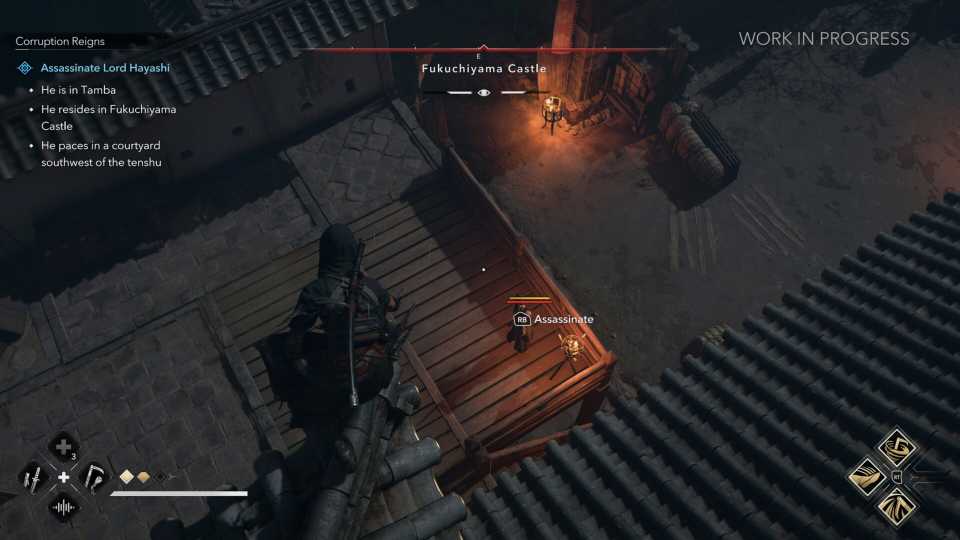
That shinobi-versus-samurai distinction that separates Naoe and Yasuke's character arcs in Assassin's Creed Shadows' plot also extends to gameplay. As a shinobi (or, ninja), Naoe embodies the classic Assassin's Creed protagonist toolkit. She excels at a more stealthy approach, capable of using a wide array of tools such as kunai, shuriken, smoke bombs, and more to distract enemies or quickly retreat from combat encounters after detection. She's still capable of fighting enemies head-on, but the flow of her combat style is skewed heavily toward deflection and dodging, complete with an impressive variety of special attacks that emphasize her mobility and speed.
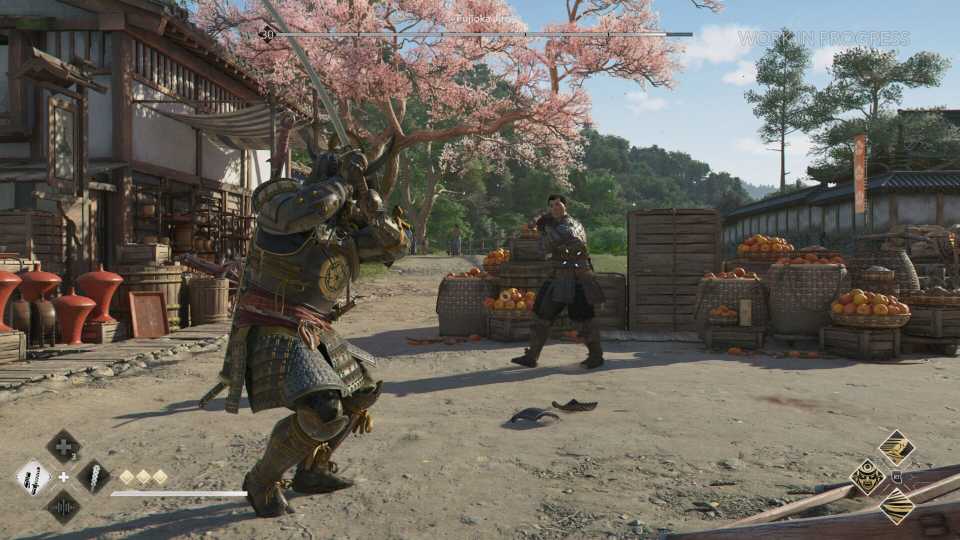
Yasuke, on the other hand, is tantamount to an unstoppable force. As a samurai, Yasuke is incredibly adept with a blade and wields his standard long katana, naginata, heavy kanabō, teppo, and bow. He can smash through doors or barricades, is capable of withstanding far more punishment from enemies, and can easily break foes' posture with heavy strikes in rapid succession. What Yasuke lacks in stealth, he more than makes up for by being the ideal choice for any scenario in which head-on confrontation is unavoidable, making him the perfect counterpoint to the more traditional stealth sandbox afforded by choosing to play as Naoe.
Together, both heroes complement one another perfectly, and each feels just as necessary as the other. It's also worth noting that Assassin's Creed Shadows features plenty of missions that are specifically locked behind one character or the other, encouraging and incentivizing players to regularly play with both heroes to develop their skills and get a feel for the different approaches to combat offered by either. So, while most players won't want to select Yasuke to trounce around rooftops and reach the various Viewpoints dotting the map (something which only Naoe is capable of anyway), they also wouldn't necessarily want to select Naoe as their hero for an all-out assault on a castle containing several elite enemies and challenging Samurai Daisho. Both of Assassin's Creed Shadows' playable protagonists have their strengths and weaknesses, and the game rewards you for choosing the right hero for the right situation.
The Ubisoft Open-World Format Is At Its Best In Assassin's Creed Shadows
Of course, the different approaches to combat and exploration offered by playing as either of Assassin's Creed Shadows' dual protagonists wouldn't mean much if the open-world sandbox wasn't worthwhile. Thankfully, Assassin's Creed Shadows' painstakingly researched recreation of Sengoku Period Japan ranks among the franchise's greatest open worlds. Visually, Shadows' map is consistently impressive, especially where weather effects and foliage are concerned. There were several moments where I found myself stopping to smell the virtual roses, regularly opening up the game's Photo Mode to capture some of the impressive artistry on display.
While 2020's Ghost of Tsushima takes place in 13th century Japan during the course of the first Mongol invasion and Rise of the Ronin transports players to the Bakumatsu Period following the end of the Tokugawa Shogunate, Assassin's Creed Shadows takes place right between the two in Sengoku-era Japan. This 16th-century playground paints Japan as a country rich with natural beauty that is slowly becoming more modernized thanks to the influence of outside cultures, and it looks vastly different from what similar games offer in their virtual recreations of the nation. In particular, the abundance of castles and the impressively detailed and bustling city streets in areas like Kyoto or Osaka offer some of the most impressive historical tourism in a series that has made that one of its trademark features.
But that's not to say that Assassin's Creed Shadows' open world is perfect. Despite offering up some impressive verticality and visual spectacle, the castles that dot the game's landscape and serve as major objectives to clear do start to feel a little too similar, especially after you've completed a few of them. And while the detail put into Japan's natural landscape has resulted in Assassin's Creed Shadows' map being visually stunning, it also has the less-desirable effect of restricting players to the map's roads and populated areas. The forests and mountains of Japan might look great in Assassin's Creed Shadows, but they're essentially window-dressing that the player isn't meant to directly interact with. While there are no "invisible walls" preventing players from trying to climb up steep hills or cross through dense woodlands to reach an objective marker, the game throws so many obstacles at the player that it makes sticking to well-treaded paths the optimal course.
Side Activities and Optional Open-World Content Are Consistently Rewarding in Assassin's Creed Shadows
The main quest in Assassin's Creed Shadows is just one of several activities players can pursue with either Yasuke or Naoe at any time, and Shadows' variety of optional content is both worthwhile and impressive. In addition to the main group of targets that Naoe and Yasuke unite to topple, there are several sub-groups of enemies that offer up some satisfying assassination quest lines. To reach each of these targets, players will need to build up their hideout, which ultimately results in gaining a wider network of Scouts that can be used to gather intel across Japan. The more optional side content players take on, the greater this Scout network becomes, opening up further content to pursue as players begin to grow the new League under Naoe and Yaskue's leadership.
There are sumi-e paintings to complete that unlock pets for the hideout and decorations to use in buildings, kofuns to raid that reward some powerful gear and advance the story of the Brotherhood's history in Japan, bandit-hunting quests that offer tiered rewards for each total you clear, kuji-kiri mediations for Naoe, rival samurai to duel for Yasuke, and so much more. Each of these side activities offers worthwhile rewards for either character, your hideout, or both, and advancing the level of the hideout only further opens up more side content that gives way to greater rewards in a very satisfying progression loop.
While I would've liked to see the hideout itself utilized more, the actual act of building it out and customizing it is well-implemented and offers up a nice distraction from the core gameplay loop that should become a consistent feature in future Assassin's Creed games. Getting to precisely plot out the buildings, foliage, decoration, paving, and amenities of your assassin hideout and then proceed to walk around it as either Naoe or Yasuke to take in the fruits of your labor is very rewarding, and it scratches an itch for fans of Assassin's Creed games who might also enjoy games with base-building or survival/crafting elements.
That said, the Scout network does somewhat discourage players from intently exploring Assassin's Creed Shadows' world, which is somewhat disappointing. Rather than act as a network of NPCs that players can meet up and interact with throughout the map, Scouts are a resource that grows with the level of the hideout, and their functions are controlled entirely from in-game menus. Using a Scout to search for a particular target or gather resources from a conquered castle is all done through the press of a button or an in-game menu where it could've been more involved, but that's an otherwise minor gripe for a new system that adds a lot of depth to the Assassin's Creed series' gameplay loop.
Assassin's Creed Shadows' Combat Sandbox Deftly Mixes Arcade-Style Action and Stealth
The older Assassin's Creed games might have placed a greater emphasis on stealth than outright confrontation, but each of the modern games in the series, beginning with Assassin's Creed Origins, have given the player some impressive toolkits when it comes to how they handle combat. Assassin's Creed Shadows continues the modern AC games' penchant for fast and fluid arcade-style combat, but the increased emphasis on swordplay sees the title utilizing a new parry mechanic that practically governs the flow of each encounter.
Whether playing as Naoe or Yasuke, Assassin's Creed Shadows' combat typically involves fighting either one enemy or groups of them, locking onto foes and trading blows while folding in defensive options. Since most opponents will be wielding swords, the most common attack players will need to respond to is a parryable one. Regular attacks that can be parried are highlighted with a white circle just before the enemy strikes, creating a fairly forgiving window for players to deflect the blow and quickly respond with a counterattack. There are also blue parries for multi-strike attacks and red parries for unblockable attacks. The unblockable red attacks can be deflected by Yasuke when wearing special armor with that perk, but Naoe has no option other than to dodge. However, if Naoe dodges out of the way of an unblockable attack at the last minute, the enemy becomes vulnerable, setting them up for a devastating counter-attack.
The color-coded warnings and prescribed responses they call for give way to a combat system that has a satisfying flow and feel, where careful observation and playing it safe creates opportunities for visceral and brutal counters to leave a trail of bodies behind either of Assassin's Creed Shadows' protagonists. While Yasuke is undoubtedly better-suited to direct combat, Naoe is no slouch, and many of her best weapons apply afflictions like bleed or poison damage that, when it procs, completely de-fangs any imposing enemy. Naoe is also the default "classic" Assassin's Creed protagonist and has a wide variety of stealth options at her disposal, including an entire skill tree dedicated to eventually being able to assassinate multiple enemies at a time or take down challenging foes with a single undetected strike.
Shadows Delivers One of the Assassin's Creed Series' More Tightly-Paced Adventures
Like the other modern Assassin's Creed games, Assassin's Creed Shadows starts with a fairly boilerplate revenge tale before the curtain is pulled back to reveal that there are far more powerful and sinister forces at play, changing the scope of the story's main conflict and seeing the adventure begin in earnest. Players start as Yasuke for a brief section before switching to Naoe for what feels like a longer, extended tutorial sequence before eventually uniting and beginning the main quest properly. But while Origins, Odyssey, and especially Valhalla had long campaigns that somewhat struggled to maintain momentum in their mid-to-late sections, Shadows is a brisk experience that values the player's time and delivers one of the best campaigns in the series' history.
Ahead of Assassin's Creed Shadows' release, Ubisoft announced that most players will complete the main story in 40-50 hours, which is a far cry from the 100+ hours necessary for Valhalla or the 70+ necessary for Odyssey. However, that doesn't take into account that players will need to make sure to occasionally dabble in side content, as Assassin's Creed Shadows' approach to enemy scaling means that players will sometimes need to gain a level or two before they're fit to tackle the next main region of the game's map. That said, these instances are few and far between, and simply following the critical path will almost always see both Yasuke and Naoe well-equipped to face whatever challenges the game throws at them.
By the time I completed the main quest of Assassin's Creed Shadows and proceeded to the Epilogue section, my total playtime sat right at around 38 hours. This included several dalliances for focusing on side content, exploring the map, and attempting to level up and equip both Naoe and Yasuke enough to where endgame encounters were no trouble.
Truthfully, Assassin's Creed Shadows does play it a bit safe and formulaic with its open world. But when the formula is as good as it is in this iteration of the Assassin's Creed franchise, it's hardly a knock against it. After spending about 40 hours traveling around Sengoku-era Japan as both a stealthy shinobi and a powerful samurai, there was still had plenty of untouched side content left to tackle and several endgame quests that demanded both of my heroes to be at levels far beyond their current power. To fully complete Assassin's Creed Shadows, and to dig into every optional piece of side content that further enriches the game's (and the series') plot, one could easily spend another 40 hours. By the time the credits rolled on Assassin's Creed Shadows, it surpassed Odyssey and Black Flag as one of the best in the franchise, and the thought of spending another 40 or so hours completing everything the game has to offer will have fans ready to re-immerse themselves





-
 OpenCritic Reviews
- Top Critic Avg: 81 /100 Critics Rec: 82%
- Released
- March 20, 2025
- ESRB
- Mature 17+ // Blood and Gore, Intense Violence, Language
- Developer(s)
- Ubisoft Quebec
- Publisher(s)
- Ubisoft









WHERE TO PLAY







- Platform(s)
- PlayStation 5, Xbox Series X, Xbox Series S, PC
- A well-paced adventure that delivers one of the best stories of the modern Assassin's Creed games
- Naoe and Yaskue are dual protagonists with compelling character arcs and distinct toolkits
- One of the most stunning and detailed open-worlds in the Assassin's Creed series that faithfully recreates Sengoku-era Japan
- Fast and fluid combat with options for a stealthy approach or all-out confrontation
- Open-world elements do stick to the well-established series formula
- Some environmental assets begin to feel copied and pasted from previously visited areas
Assassin's Creed Shadows releases on March 20, 2025, for PC, PlayStation 5, and Xbox Series X/S. The Best War Games was provided a PC code for this review.