


Summary
- Modern puzzle games require meticulous note-taking and problem-solving beyond just thinking.
- Games like "Keep Talking and Nobody Explodes" and "The Swapper" demand detailed tracking and analysis.
- Titles such as "Baba Is You," "Heaven's Vault," and "The Witness" challenge players intellectually and expect diligent note-taking.
Modern puzzle games may come with slick interfaces and digital journals, but the ones that really mess with players’ heads are the ones that don’t care if they forget what they saw in Room 4C. These games expect players to be not just thinkers, but scribblers — tracking patterns, drawing diagrams, decoding languages, and occasionally whispering “what does this even mean” to an open notebook.
The following titles reward that level of dedication, and in most cases, flat-out require it. Notepads, whiteboards, conspiracy corkboards —players can use whatever works to try and keep track of these puzzles and find a solution.

8 Best Puzzle Games With Story-Driven Campaigns
Not all puzzle games are pointlessly nerve-racking; some come with compelling storytelling that turns puzzle-solving into an intriguing adventure.
8 Keep Talking and Nobody Explodes
Cut the Wrong Wire and Friendship Dies in Real Time

Keep Talking and Nobody Explodes





- Released
- October 8, 2015



WHERE TO PLAY




- ESRB
- e
- Genre(s)
- Puzzle
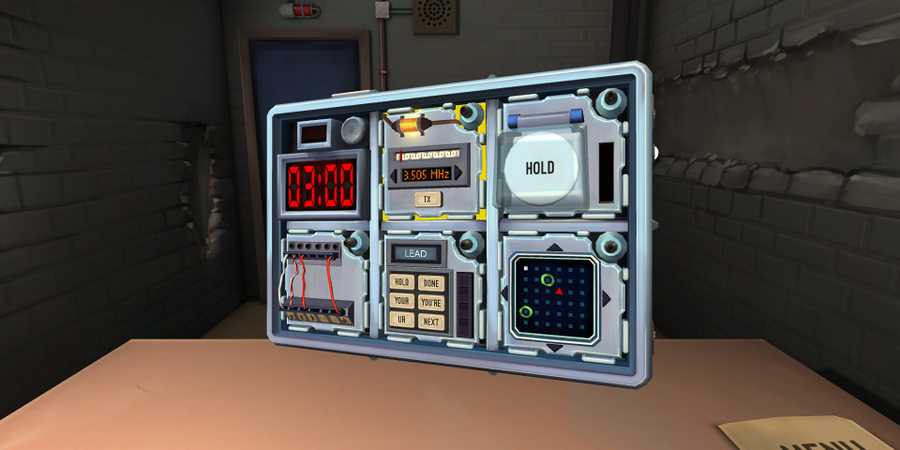

There are few co-op experiences as gloriously chaotic as Keep Talking and Nobody Explodes. One person has the bomb, the others have the manual, and neither group can see what the other sees. It’s part party game, part panic attack, and all about communication. While it may look like a novelty at first glance, this thing has layers.
Manual readers eventually realize they need to write everything down just to survive past the first few modules. Serial numbers, wire orders, Morse code sequences — if it’s not documented, it’s forgotten. In a game where a missed detail can mean blowing your friend to bits, that’s not ideal. As the puzzles ramp up, so does the pressure, and players find themselves sketching logic trees and shorthand like they’re trying to crack a Cold War cipher.
7 The Swapper
The Clone Problem That Will Break Your Brain

The Swapper
- Released
- May 13, 2013
WHERE TO PLAY

- ESRB
- E For Everyone 10+ // Mild Violence, Mild Language
- Developer(s)
- Carlo Castellano, Tom Jubert, Olli Harjola, Otto Hantula

At first glance, The Swapper looks like a contemplative sci-fi platformer wrapped in eerie claymation visuals. But then it hits players with a mechanic that might as well be a philosophical dilemma: create clones of yourself and swap between them to solve spatial puzzles. Simple enough — until it's not.
While it's technically about moving blocks and flipping switches, The Swapper quietly asks players to reckon with questions of identity and autonomy. Tracking which clone is where, which one’s active, and how gravity is affecting each of them turns into an exercise in frantic note-taking. Players often end up drawing layouts of entire rooms, marking clone positions and light sources to make sure they’re not leaving a body behind — or accidentally vaporizing the one they’re currently inhabiting.
6 Baba Is You
Syntax is Suffering and Logic is the Weapon

Baba Is You
- Released
- March 13, 2019
WHERE TO PLAY

- ESRB
- e
- Developer(s)
- Hempuli
- Genre(s)
- Puzzle

What begins with pushing blocks turns into pushing the English language itself. Baba Is You doesn’t just bend the rules of its world — it lets players rewrite them mid-level. “Wall is Stop” becomes “Wall is Push.” “Baba is You” becomes “Rock is You.” This isn’t a game that players can brute-force. Every level is a self-contained logic puzzle, and each one feels like it’s trying to trick the player into thinking outside the screen.
Most players end up drawing diagrams of the current word structure and mapping out permutations before making a single move. Mistakes are common, restarts are frequent, and the "aha!" Moments feel like mini-graduations. Later puzzles introduce recursive logic, conditionals, and even metaphysics. There are levels where players have to write rules about writing rules. It’s less a puzzle game, and more a programming course disguised as a pixelated fever dream.
5 Heaven’s Vault
Learning a Language No One Else Speaks

Heaven's Vault
- Released
- April 15, 2019


WHERE TO PLAY

- ESRB
- T For Teen: Suggestive Themes
- Developer(s)
- inkle studios
- Genre(s)
- Indie, Adventure

Inkle’s narrative-rich Heaven’s Vault is the only entry on this list that turns note-taking into actual archaeology. Players step into the role of Aliya Elasra, a historian deciphering a long-dead alien language across a crumbling interstellar empire. The catch? That language isn’t translated. Players have to do it themselves.
There’s no Rosetta Stone here — just intuition, syntax, and dozens of interconnected inscriptions across scattered ruins. Players build their own lexicon, cross-referencing word fragments, sentence structures, and glyph clusters in their journal. One wrong translation can send the narrative spiraling in a different direction.

8 Best Video Games Where You Play As A Scientist, Ranked
Science-based mechanics rarely find their way into video games, but there are plenty of video game heroes who are well-trained and capable scientists.
The game respects intelligence and patience, and expects players to return to old texts with new insights. By the halfway mark, the notebook starts to look like a conspiracy map from a noir detective story, full of scratched-out guesses and speculative arrows. It’s messy, but that’s the fun of it.
4 The Talos Principle
The Turing Test's Philosopher Cousin

The Talos Principle

- Released
- December 11, 2014
WHERE TO PLAY
- ESRB
- T For Teen Due To Mild Language, Mild Sexual Themes, Mild Violence
- Developer(s)
- Croteam
- Genre(s)
- Puzzle
Set in a sun-bleached simulation filled with Greco-Roman ruins and philosophical audio logs, The Talos Principle lures players into what looks like a Portal-like experience. But it doesn’t take long before it starts asking questions about sentience, autonomy, and what it means to be “you.” The puzzles themselves revolve around lasers, jammers, and recording mechanics that require careful planning and even more careful execution. But it’s the hidden sigils and secret puzzle layers that make note-taking essential. Players frequently jot down sigil locations, hidden star placements, or weird messages from QR codes found on walls — some left by other “players” trapped in the simulation.
Then there’s the computer terminals, filled with fragments of old texts, philosophical debates, and emails from scientists who may or may not exist. Players who track the branching dialogue trees and parse the hints tucked within seemingly unrelated conversations tend to unravel deeper meanings most would miss. It’s like solving mazes with both the hands and the mind.
3 Return of the Obra Dinn
Drawing Timelines and Crew Rosters

Return of the Obra Dinn
- Released
- October 18, 2018

WHERE TO PLAY
Lucas Pope somehow turned a shipwreck into one of the most intricate murder-mystery simulators ever made. In Return of the Obra Dinn, players board a derelict East India Company ship with nothing but a magical pocket watch and an insurance ledger. From there, it’s up to them to figure out the fates of 60 souls.

9 Best Crime Solving Games, Ranked
Put your detective skills to the test and channel your inner Sherlock with these brilliant crime-solving games.
This isn't detective work in the traditional sense. It’s more like information forensics. Players listen to dying moments, study clothing, parse accents, observe body language, and then cross-reference it all with ship manifests. Half the time is spent rewinding scenes, but the other half is spent flipping through notes, scribbling theories, and redrawing seating charts from the crew’s last dinner. The black-and-white 1-bit art style might be nostalgic, but the puzzle design is anything but retro. It demands observation, deduction, and good old-fashioned note-taking.
2 Fez
A Game That Pretends to Be About Jumping, But It's Actually About Noticing

Fez
- Released
- April 13, 2012
WHERE TO PLAY



- ESRB
- E For Everyone due to Mild Fantasy Violence
- Developer(s)
- Polytron Corporation
- Genre(s)
- Puzzle, Platformer
Phil Fish’s Fez is a wolf in pixelated sheep’s clothing. What starts as a charming 2D platformer quickly becomes a multi-layered meta-puzzle involving secret languages, hidden dimensions, and cryptographic insanity. The big twist is the ability to rotate the world in 3D, revealing new paths and environmental clues. But the real depth comes later, when players stumble onto ancient glyphs, numerical systems, and audio puzzles that require spectrogram analysis. Yes, there are people who solved Fez using audio editing software.
There’s even an entire in-game alphabet to decipher, and it's never explained. Players fill up notebooks with translation charts, level diagrams, and rotated maps. It’s the kind of game where scribbling down a sequence of symbols on a napkin while half-asleep is completely normal. Some puzzles remained unsolved for weeks after release, and even now, new players often turn to fan communities just to make sense of what they’ve found.
1 The Witness
Bring a Journal, and Maybe a Therapist

The Witness
- Released
- January 26, 2016
WHERE TO PLAY
- ESRB
- E For Everyone due to Alcohol Reference
- Developer(s)
- Thekla Inc.
- Genre(s)
- Puzzle

Jonathan Blow’s The Witness isn’t a puzzle game; it’s a puzzle world. The island is quiet, beautiful, and practically wordless — until the panels start showing up. Every puzzle begins with a line. Just draw it from point A to point B. Then it starts layering rules. Symmetry. Color filters. Perspective tricks. Environmental illusions. And at no point does it explain anything. Players are expected to learn purely through observation.
By the second hour, most players have sketched out grid patterns, taken photos, and started building their own reference libraries for puzzle types. By the tenth hour, they’re solving environmental puzzles that use shadows from the sun, or reflections in puddles, or even gaps between tree branches. And then there’s the optional puzzles, which hide in plain sight and often require a second or third playthrough to notice. Some players spend months mapping out everything. Others still haven’t found the secret ending. But that’s The Witness — a game that doesn’t just expect note-taking, it quietly weaponizes it.

7 Best Philosophical Puzzle Games
There are plenty of puzzle games out there for gamers to try, but not all of them embrace philosophical themes. Here are the best that do.