


Players set their own goals in Crusader Kings 3, but it always feels good to start out as a lowly count and climb the ranks to become a king or even an emperor. With enough time, experienced players can even conquer the map and fold it all into a single massive empire.
The first step in this process is to create or inherit a higher title and rank up, but this process can be difficult for a new player of Crusader Kings 3 to understand. This guide will explain how the rank system works, what the requirements are for creating new titles, and how players can use the system to make their rulers more powerful.

Crusader Kings 3: How to Station Troops
The new stationing mechanic replaces the universal bonuses players used to get from holding improvements.
Title Ranks

The most basic unit of land in the game is a Holding. Each Holding can contain a settlement, and these settlements are Castles, Temples, Cities, or Tribes. A Holding can also be empty, but the Holding owner can build a settlement on it if they have enough Gold and the right Innovations and government.
Every Holding is part of a County. A County can contain 1 to 6 Holdings. The ruler of a County is considered a Count, even if their culture or government would call them something else. A Count usually controls one or two Holdings in the County, and the rest are controlled by Barons. Again, the in-game name can be something else, but a Baron can only control individual Holdings (or Baronies). Player rulers have to be Counts or better, and so Barons are always NPCs.
Every County is part of a Duchy. There are hundreds of Duchies in the CK3 map, and these Duchies can contain 1 to 9 Counties. Many Duchies are based on historical divisions, but often they're just a way for Paradox Interactive to evenly divide the map. The ruler of a Duchy is known as a Duke.
Every Duchy is part of a Kingdom. There are dozens of Kingdoms on the map, and once again they aren't all completely historical. Most Kingdoms include at least 2 Duchies, but some, like Bohemia and Brittany, only contain 1. While Duchy borders can never change, Kingdom borders can. If a King completely controls a Duchy that's next to the de jure Kingdom borders, the Duchy will slowly "drift" into that Kingdom.
Every Kingdom is part of an Empire. There are just 29 Empires in CK3, at least at the start of the game. The head of an Empire is an Emperor. Every Empire includes at least 2 Kingdoms. Just like Duchies, completely controlled Kingdoms can "drift" into neighboring Empires.
All of these titles have something called de jure Counties. This refers to the territory that appears on the Titles map modes. Players can check where they are by choosing the Duchy Titles, Kingdom Titles, and Empire Titles buttons in the lower-right corner of the screen. Their icons are the three crowns with the green, red, and purple backgrounds. Players can also use these view modes to create new titles by clicking on them and bringing up the title menu.
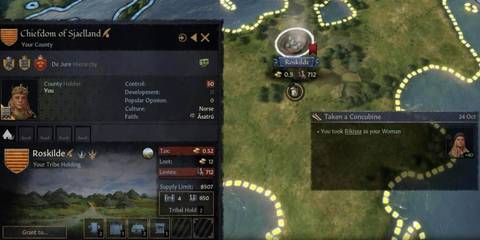
Another way to create a title is through the Current Situation widget at the top of the screen. If players can create a new title, it'll show up in the dropdown list. A third way is to select a County and check the "De Jure Hierarchy" line near the top of the County view. Clicking on one of the shields on this line will bring up its title menu.

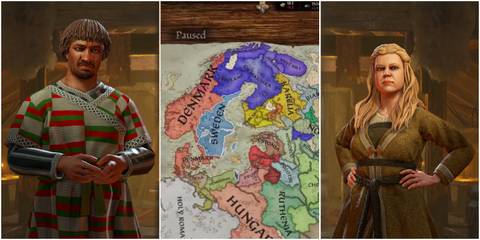
Crusader Kings 3: How to Use the Council
If players want to get anything done in their realm, they'll need a good council to put their thoughts into action.
Title Creation

To reach a new rank in Crusader Kings 3, players must be able to create a title of the rank above them. To do that, the player ruler must meet some requirements.
Control
The ruler must control, directly or though vassals, over half the de jure Counties of a Duchy or over half the Counties of a Kingdom. To create an Empire, the ruler must control 80 percent of the Empire's Counties.
Clout
To create a new Duchy, the player ruler must be a Count or higher. That's easy enough since player rulers can never be less than a Count. However, to create a new Kingdom, player rulers must already hold at least two Duchies. This is true even if players want to create a one-Duchy Kingdom like Brittany. Likewise, player rulers must hold at least two Kingdom titles to create an Empire. However, a ruler who's already a King or Emperor can create new Kingdom titles without needing extra Duchies.
Cash
Creating a Duchy title costs 250 Gold, a Kingdom costs 500, and an Empire costs 1000.
Headroom
If the player ruler is a vassal, they can never hold a title equal to or higher than their liege's highest title. Of course, there are multiple ways to go independent or claim a liege's title, but that goes beyond the scope of this guide.
Another way to reach a new rank is with the "Found a New Kingdom/Empire" decisions. Here's what player rulers need:
- The rule "Custom Kingdoms" is set to on
- The ruler is an adult, at peace, and independent
- The realm contains 3 Duchy titles or 30 Counties for a new Kingdom, or 3 Kingdom titles and 80 Counties (or 120 Counties) for a new Empire
- Level 3 or 4 Fame
- 300 or 1200 Gold
- 500 or 2000 Prestige
- 200 or 600 Piety
By doing all that, players can create a new Kingdom or Empire, and all the Duchies or Kingdoms held by the player ruler will become part of the new title's de jure territory.
Player rulers can also gain new titles and ranks by overthrowing their lieges or inheriting them through relatives. Even so, knowing how to create new titles will serve players well as they dive into the complex world of Crusader Kings 3.
Crusader Kings 3 is available now on PC, PS5, and Xbox Series X/S.

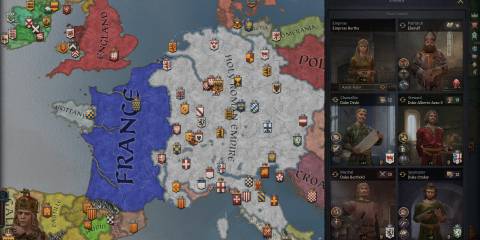
Crusader Kings 3: How To Form An Empire
Forming an empire is pretty straightforward in Crusader Kings 3, but maintaining it takes no small amount of effort.


-
 OpenCritic Reviews
- Top Critic Avg: 90 /100 Critics Rec: 99%
- Released
- September 1, 2020
- ESRB
- T for Teens: Drug Reference, Language, Mild Violence, Suggestive Themes
- Developer(s)
- Paradox Interactive
- Publisher(s)
- Paradox Interactive





WHERE TO PLAY


Your legacy awaits. Choose your noble house and lead your dynasty to greatness in a Middle Ages epic that spans generations. War is but one of many tools to establish your reign, as real strategy requires expert diplomatic skill, mastery of your realm, and true cunning. Crusader Kings III continues the popular series made by Paradox Development Studio, featuring the widely acclaimed marriage of immersive grand strategy and deep, dramatic medieval roleplaying.
Take command of your house and expand your dynasty through a meticulously researched Middle Ages. Begin in 867 or 1066 and claim lands, titles, and vassals to secure a realm worthy of your royal blood. Your death is only a footnote as your lineage continues with new playable heirs, either planned… or not.
Discover a sprawling simulated world teeming with peasants and knights, courtiers, spies, knaves and jesters, and secret love affairs. An extensive cast of historical characters can be romanced, betrayed, executed, or subtly influenced.
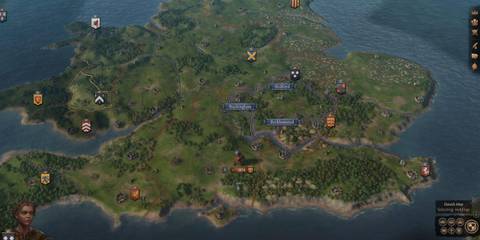
Explore a vast medieval map stretching from the snowswept Nordic lands to the Horn of Africa, and the British Isles in the west to the exotic riches of Burma in the east. Claim, conquer, and rule thousands of unique counties, duchies, kingdoms, and empires.
- Engine
- Clausewitz Engine
- Multiplayer
- Online Multiplayer
- Franchise
- Crusader Kings
- Platform(s)
- PS5, Xbox Series X, Xbox Series S, PC
- Genre(s)
- RPG, Grand Strategy
- How Long To Beat
- 70 Hours
- X|S Optimized
- Yes
- PS Plus Availability
- Extra & Premium
- File Size Xbox Series
- 11 GB (November 2023)
- OpenCritic Rating
- Mighty
