

The level scaling approach in Elden Ring is a finely tuned amalgamation of difficulty and exploration and distinguishes it from many other open-world games where level scaling can feel artificial or immersion-breaking. Firstly, in Elden Ring, the world is structured in a way that both entices and intimidates its players. The lack of explicit level scaling means that venturing into areas beyond the player’s capacity can lead to punishing encounters.
Secondly, many MMOs and other open-world games use level scaling to provide continuous content across different zones. But this often dilutes the sense of achievement, which is not the case with Elden Ring. The gameplay never feels as dangerous or mysterious when enemies are always scaled to the protagonist’s current level, and while this approach might make the exploration in such games uniform, it does make it far less challenging.

All Bows In Elden Ring, Ranked
FromSoftware's Elden Ring prioritizes melee combat, but the tarnished can fight from a distance as well. What are the best bows in the game?
Why Elden Ring’s Level Scaling Approach Is Near-Perfect
The punishing encounters in Elden Ring are intentional and make it a high-stakes game. They’re part of the Souls formula where the player is meant to learn, adapt, and return stronger. When players manage to survive in tougher regions or overcome a high-level boss, the rewards feel truly earned because they are achieved through overcoming significant stat gaps and mechanical mastery.
In contrast, in games like Skyrim with level scaling, the challenge remains more predictable, and rewards may not feel as impactful, as the difficulty and loot are constantly adjusted to match the player's current level. While this might make the game easy to chew for the franchise’s target audience, it makes the exploration arguably less dynamic.
Elden Ring Hypes up Power Fantasy and Makes It Clear That There’s a Difficulty Curve
One of Elden Ring's strengths is how it preserves the "power fantasy" aspect of RPGs. As a player levels up and obtains better gear, they genuinely feel stronger. For example, Dota 2, which does have some RPG elements, also executes this well, with heroes leveling up in each game and taking on simple creeps that could’ve easily killed the player earlier in the game. Elden Ring enemies that once were overwhelming can be revisited later, and killing them feels rewarding.
There’s High Risk and High Reward in Exploration
Another element that makes Elden Ring excel in its level-scaling approach is its risk-reward system. The decision to enter a high-level area is an important one, and if the player manages to survive, the rewards are often greater in terms of experience, items, and the feeling of triumph. This further encourages Elden Ring players to push their limits.
Games that use level scaling often end up with a more linear approach to progression. Players engage with content that feels appropriate to their character regardless of when they approach it, and the end reward or sense of achievement may change.
FromSoftware Designs Its Worlds To Feel Dangerous
FromSoftware designs its worlds to feel foreboding, which is essential to the Soulslike experience. The lack of level scaling reinforces this because players are constantly aware of their own limitations within the game's world. Venturing into the unknown requires preparation and caution and that’s any gaming geek’s motivation to wake up and grind. It creates an atmosphere where the environment itself feels hostile, and player choice remains a key factor in survival.
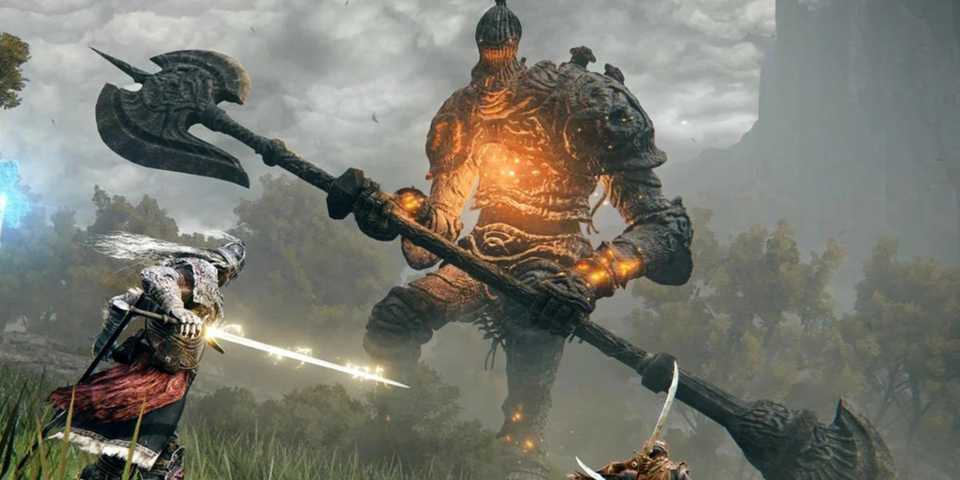
Where many games use level scaling to ensure all content remains accessible and balanced for players at different stages, Elden Ring takes the opposite approach. The game lets the world dictate the player's progress, such as encountering the Tree Sentinel early on, rather than artificially adjusting challenges to the player’s level or opting for a more standardized approach to difficulty.


Elden Ring



-
 OpenCritic Reviews
- Top Critic Avg: 95 /100 Critics Rec: 98%
- Released
- February 25, 2022
- ESRB
- M for Mature: Blood and Gore, Language, Suggestive Themes, Violence
- Developer(s)
- From Software
- Publisher(s)
- Bandai Namco Entertainment, From Software



WHERE TO PLAY




ELDEN RING, developed by FromSoftware, Inc. And BANDAI NAMCO Entertainment Inc., is a fantasy action-RPG adventure set within a world created by Hidetaka Miyazaki and George R.R. Martin. Danger and discovery lurk around every corner in FromSoftware’s largest game to date. Hidetaka Miyazaki - President and Game Director of FromSoftware Inc. Known for directing critically-acclaimed games in beloved franchises including Armored Core and Dark Souls.
George R.R. Martin is the #1 New York Times bestselling author of many novels, including the acclaimed series A Song of Ice and Fire - A Game of Thrones, A Clash of Kings, A Storm of Swords, A Feast For Crows, and A Dance with Dragons. As a writer-producer, he has worked on The Twilight Zone, Beauty and the Beast, and various feature films and pilots that were never made. He lives with the lovely Parris in Santa Fe, New Mexico.
- Engine
- Proprietary
- Multiplayer
- Online Co-Op, Online Multiplayer
- Cross-Platform Play
- PS4 & PS5 and Xbox One & Xbox Series X|S
- Cross Save
- no
- Steam Deck Compatibility
- yes
- Platform(s)
- PC, PlayStation 4, PlayStation 5, Xbox One, Xbox Series S, Xbox Series X
- How Long To Beat
- 58 Hours
- X|S Optimized
- yes
- PS Plus Availability
- N/A
- OpenCritic Rating
- Mighty
