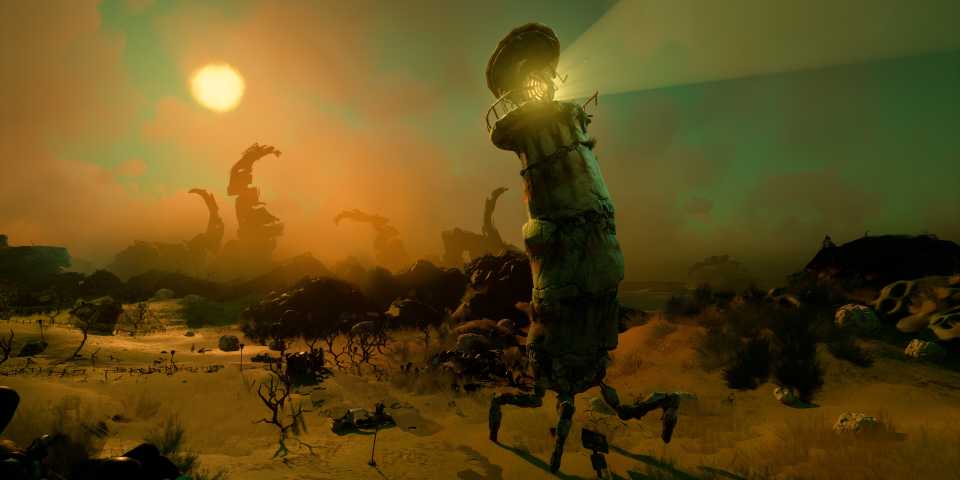
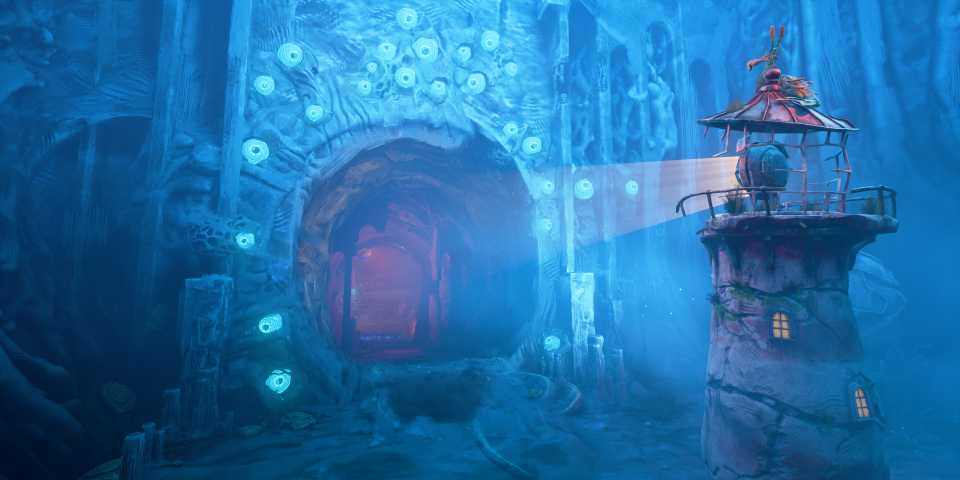
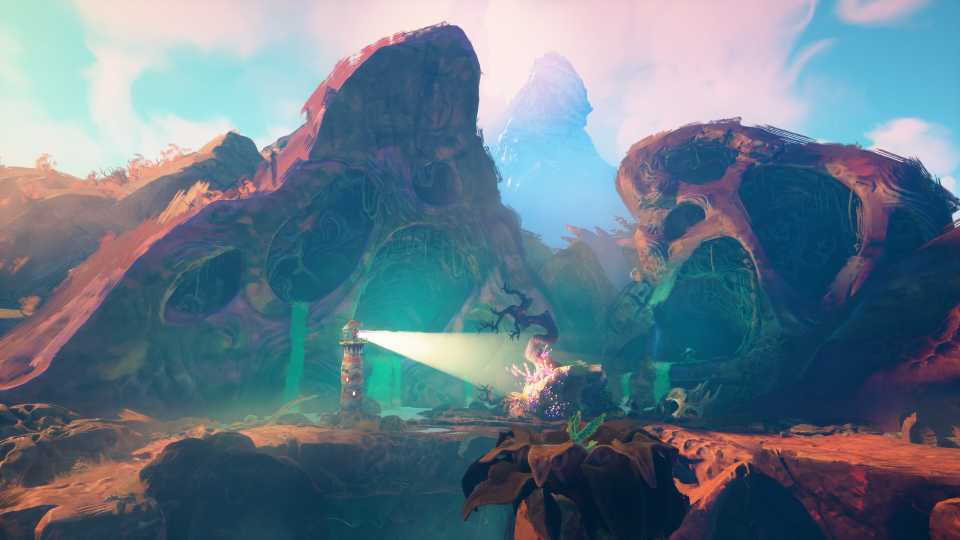
Double Fine's Keeper will be bringing fans of the surreal and strange something truly special. An adventure through a wordless world led by a walking lighthouse and a seabird, Keeper will easily stand out from the crowd.
Coming to Xbox Game Pass day one, Keeper gives players an eldritch adventure set within a world void of dialogue and human contact, where a living lighthouse and a light-shy seabird embark on an adventure through surreal vistas. The Best War Games caught up with creative director Lee Petty, who spoke about its story and various aspects of gameplay. The following transcript has been edited for clarity and brevity.
Keeper Creative Directive Talks Crafting A Surreal World Without Words
The Best War Games: What is it about the world and story of Keeper that stands out as special? What ties all the game's unique and surreal concepts together?
I think there are two aspects there worth mentioning. The first is from the origin of the project; I'm a big outdoor person in terms of hiking, backpacking, and things like that. It's kind of where I process a lot and think, and during the pandemic, I spent a ton of time out there. It was in those moments when I thought a lot about, you know, stuff most people were thinking about: connecting to others, the meaning of that, and imagining what the world might be like in the future without humans around—where life might go and if it would still be possessed with this desire to connect with others.
Ultimately, that connection was about friendship, too. On the one hand, Keeper is about friends coming together in unusual circumstances or a strange world and overcoming obstacles together. That's kind of represented by the lighthouse and its bird companion, Twig—the two main characters in the game, as well as the basis of the puzzle mechanics.
Then the other thing is that, when thinking about, 'Why a lighthouse?' One of the things I found interesting about the lighthouse is that the game is set very much past when humanity has been around, but the lighthouse is a leftover. That lighthouse doesn't really have a function anymore. There are no ships coming, no humans to guide, so it needs to find a new purpose for itself. I think that's the other aspect of the game: change and its relationship to meaning and purpose. Those are kind of like the two fundamental themes of the game.
The Best War Games: To what extent would you consider Keeper to be 'dreamlike'?
Very much so! We're after the unexpected, for one—you know, just the idea that we're going to delight and surprise the player a lot, and that they can't necessarily see where the story is going. We'll still get some sense of closure and emotional connection with these characters, but not necessarily following the path that players are expecting. I think creating a dreamlike sensibility helps that, and we achieve that in a lot of different ways. There's certainly some stuff going on with the visuals, inspired by stuff like surrealist art—sort of juxtaposing very disparate elements to create something unusual together.
In addition, a lot of it comes down to the levels as well. You have this overarching goal of reaching this mountain peak, at least the lighthouse does, and along the way, you're just literally stumbling through encounters with other creatures, little towns, and leftover architecture from some bygone era. Sometimes those spaces, you know, I see them, and there's a lot left for interpretation. Since this is a wordless game, I sort of see some of those as psychological spaces—not necessarily saying 'this is a physical location,' but actually we've transitioned into maybe a location inside the lighthouse's head, though there's nothing that we specifically tell the player. There are so many ways you could interpret some of the segments of the game, and I like that sort of fuzzing or blending of reality. It's not like an absurdist dream where there's no sense of physical laws, and it's just all like a crazy acid trip or anything. It's nothing like that: there's just enough of a toehold in reality and physicality that it feels, I think, dreamlike.

The Best War Games: Do you expect players to be disturbed by any of the content in Keeper, given the uncanny nature of its elements?
I think so. It's funny because, on the one hand, it has some things in common with what has been sort of called the cozy genre, but it's definitely not a cozy game. We just sort of use the term 'Weird but Chill,' like it's this really strange, unforgettable experience, but it's also something a wide audience can pick up and play. Unlike cozy games, which tend to hover in a very specific, smaller, emotional band that a lot of games don't, Keeper goes up and down and all over the place. We definitely have some moments of just pure joy and delight, but we also have some unnerving moments that make those other moments more meaningful.
Other than the game's antagonist (which is more of an ecosystem than an individual entity), all the creatures, no matter how they look, are actually quite friendly, and I think that was sort of another thing I was really interested in exploring. The game is not going by the classic character design book; I think there's an interesting thing about the assumption that these things that are big, sharp, and triangular are going to be evil and harmful. Maybe that's a commentary on video games there, or maybe it's just a commentary on what we're hardwired to think as people. But yeah, I think people may feel that way initially when kind of getting into a world, but then they'll come to realize that these are creatures and characters with their own life cycles and their own concerns. You do have something in common with them that you know evolves over the course of the game.
The Best War Games: The Keeper trailer immediately nails the surreal vibe hinted at in the game's description. What inspired the look of the game, and how did you keep the many unique locales and creatures consistent with the game's art style?
That's a great question! It's interesting because we're playing with a few ideas there, and one of which is that a lot of the lifeforms in this world—and this is, again, not entirely rational, not a very scientific way of approaching where I imagined life to go—but a lot of these creatures are hybrid on some level. They can be animal, vegetable, or mineral—inorganic or organic—and they're all kind of just fused together. Again, it comes a little bit from surrealist painting, just the idea of found objects or juxtaposition being in a lot of their work, but it's also the idea that we're sort of communicating that everything could be alive in this world.
That informed the art style a lot, and to achieve those ideas with the art, we ensured that basically everything is just sculpted in the world. Like every rock, every little thing was individually sculpted by digital artists. They weren't built from a kit and just snapped together; it was all hand-done. That then kind of led me to painting, right? Because with painting, it's just impossible not to see the human hand, for the most part. They all have this sort of organic and gestural sense. We tried to bring that directly into the art style on every level, both in terms of just like the shape language of the world and the characters, but we actually have those dynamic brushstrokes that have been created in the world to break up those harder CG edges. That's all to give the game a distinctive style, but I also think it gives the world a very bespoke, hand-touched feel. That idea communicates life, and to me—hope—even when there's something as cold as a piece of machinery.

The Best War Games: Would you say there's a 'speculative biology' element to Keeper then?
A little bit, like I've definitely read and watched a few things like that. I saw this movie called Fantastic Fungi a few years ago, near the start of development. That was an interesting one because it was all about mushrooms and related things, and it talked a lot about the mycelial network they make, how other life forms will sometimes piggyback on that same network, and they'll share nutrients among totally different species. I found that really fascinating.
I also read stuff like After Man, which was really interesting, though definitely of a more scientific ilk. I remember seeing these magnificent Victorian-era scientific illustrations of animals, where it was clear the artists had never seen the actual animal. It was like someone had described a giraffe to this artist, and it sort of looks like a dog with a long neck! I just found that stuff really fascinating—like, where we sort of take the familiar, but then imagine it in a maybe not entirely rational way. We definitely played with some of that in our characters; we even have an opening level of the game with living rocks that have weird organic feet that maybe look like a small ostrich or something. We've got these characters that almost look like a living tuber or fruit that are walking around. We have a giant tree that is missing its three eyes, which are these blue gemstones that you help retrieve from the tree, and it helps you along your way. So, yeah, there's definitely something I'd say speculative in a very fever-dream sense more than pure biology.
Keeper And Its Characters

The Best War Games: On a similar note, Keeper's lighthouse character displays a great deal of personality, despite its unconventional form. What went into the design process for this character, and how did you settle on this final iteration?
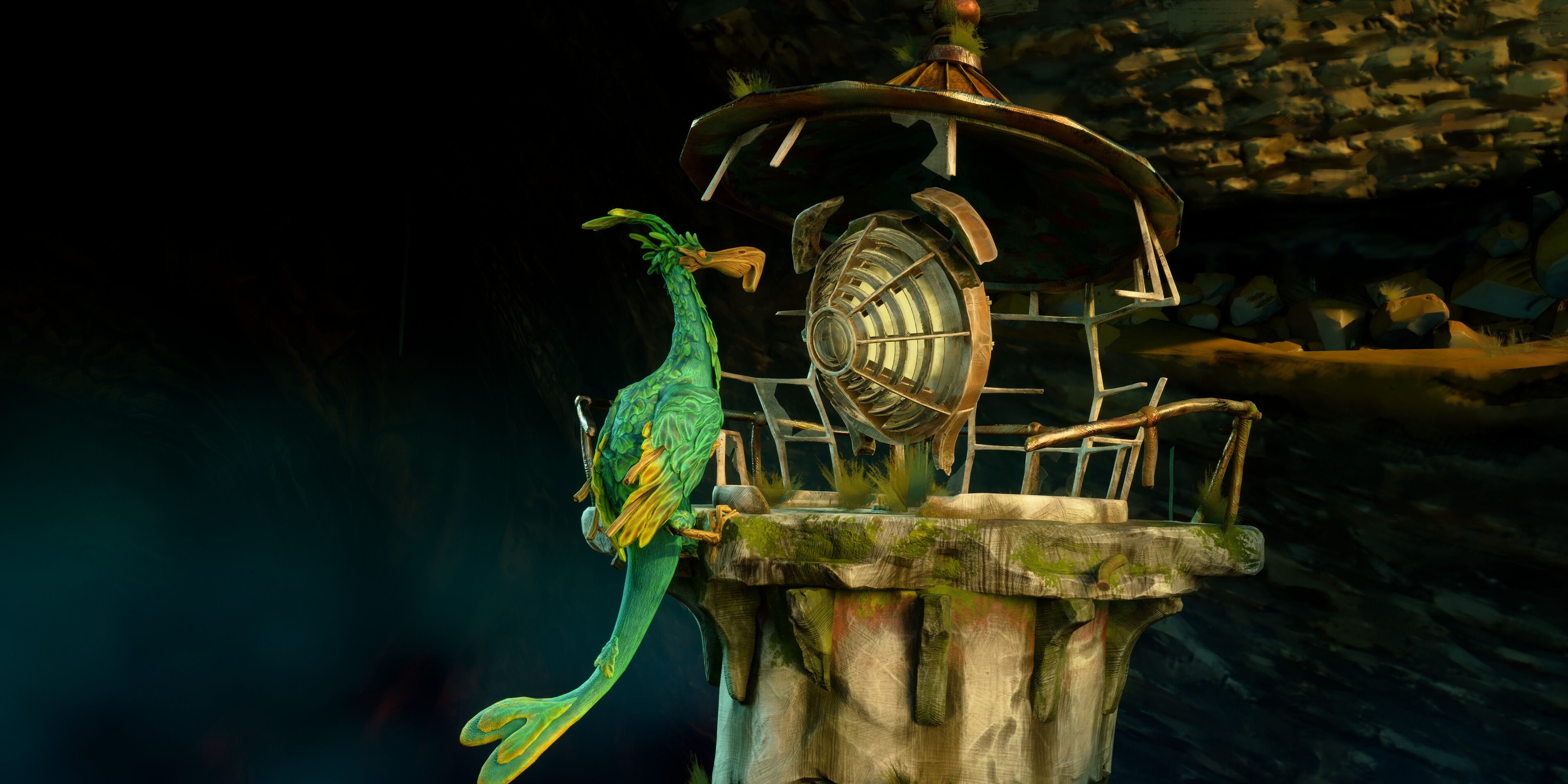
Early on, we talked to our animation team and said, 'Look, we have no words. We have cutscenes but no dialogue, so we need to make people care about this lighthouse and the bird.' The bird is a little more conventional in terms of character design because it's a little more like a toehold for people to kind of get a more emotional grounding with the lighthouse. When we started out, we sort of built this initial lighthouse, and right away we were playing with things like, 'How big are the legs to the body? How much do you want to emphasize scale? How much do we want to represent the actual, like, mechanics of how a Fresnel lens would work?'
After sort of building our base moveset, we went back and changed it a few times. One of the things we did was, well, we took the body, which is obviously typically rigid, but we sort of scored it in three main areas. The actual exterior structure is broken, so the lighthouse can kind of flex and move a bit, and there's a kind of rock filler in between that gives it an organic feeling. Even though it is quite rigid, it's got points of bending and articulation, giving these nice 'C' shapes as it moves around. The lens itself is actually not really scientific. There's a lot of variation in lighthouse lenses, but I found, like, an old lighthouse picture of a Fresnel lens that was kind of one-sided. Usually, they're more omnidirectional, and you have this metal reflector going around them to focus the light. I knew that we wanted a lot of the gameplay to focus on the light mechanic, so we had it function more like a stage light or a spotlight in some way.
We built the one-sided lens, and as we were building it, we recognized we wanted to have those more close-up moments, which, you know, sometimes in cutscenes, sometimes just like the world, we wanted to have some form of articulation there without being too goofy. We took the metal framing of the lighthouse that holds that lens, and we kind of broke off a few pieces of it, so it can actually articulate. They're almost like little eyebrows that can give some expression. It's amazing when you give an animator such a limited toolset, and how great they are at using it. It really just reveals, like, their skills on a totally different level than, say, maybe a painter, right? They just know exactly how to leverage those tools to elicit emotion and character. I'm really proud of what they did. When we were playtesting the game, even relatively early on, we got a lot of people who didn't expect to care about a lighthouse, but actually found themselves really worried about it. I thought it was a sign that we were on the right track.
The Best War Games: What was the thought behind including the other main character of Keeper, Twig the seabird? What do they bring to the table in terms of both story and gameplay?
The game opens on Twig, and it's Twig who's fleeing from the Wither, which is not a single creature, but a malevolent ecosystem—multiple creatures who are all part of this kind of purple, black, unpleasant thing. Sometimes it's visualized as a thorny bramble bush or vine, sometimes it's a swarm of black and purple creatures; either way, it's something Twig has to escape. Twig winds up colliding with the lighthouse and, in doing so, activates the lighthouse. The lighthouse's light can actually dispel the wither, so right away, there's a reason for Twig to stay there.
Twig develops their own arc alongside the lighthouse, and they're with the lighthouse for the vast majority of the game. At the start, you see that Twig is separated from the rest of their flock. So you're probably ostensibly thinking that, at some point, Twig will rejoin the flock, but the two become fast friends. What's really interesting is that, you know, the lighthouse can't really talk or emote in any meaningful way, but Twig can. If you encounter other creatures, we actually have a button on the controller dedicated just to Twig making emote sounds and animations, and that can just be used for fun and player expression. But if you do it to mirror other creatures, they'll often reply. Sometimes that's an ingredient in puzzling, but a lot of times it's just showing that Twig can connect with the other animals, whereas the lighthouse is just completely, you know, not able to. Twig can also fly out and grab and manipulate objects that the lighthouse can't because the lighthouse doesn't have hands or a way of hooking onto these things. They can both do things that the other can't, and they can work together to solve puzzles.
You also see moments emotionally where Twig is hesitant or afraid of the dark a bit. When you go into interiors or dark spaces, you can see Twig change the way its animation looks and the sounds it makes. It hunkers down around the lighthouse. But of course, the lighthouse brings light and doesn't have any fear of the dark. So I think those are some of the ways that they work together over the course of the game.
 A Story Without Words
The Best War Games: Will Keeper be the sort of game that can be explained through lore and worldbuilding, or does its imagery err more towards the metaphorical?
I would like to say that it's a bit of both, right? We've crafted a specific story that has some closure, and you'll understand these characters' journeys on some level. However, you probably won't be able to derive all the answers, and it's intended to sort of work on multiple levels. The idea there was that, hopefully, people could bring their own experiences and perspectives to it, see some of what they want to see, where their mind tends to go, and have that echo and reverberate with them.
That being said, nothing in Keeper is arbitrary. I think truly arbitrary media engages people for about 10 minutes, and then most people want a little more structure than that. I think we've tried to strike that balance, and without words, it naturally lends itself to a bit more mystery and being open for interpretation. But we do have some hard lore things; we have the series of sculptures that you find along the way, some optional content. We call them Glyphs and they're kind of in a destroyed state, but the lighthouse can use its light to kind of grow vines to pull them back together. Although there aren't words directly associated with them, they do kind of create these images that tell a bit of the backstory and history of the island and some of the events that have gone on.
There are little bits of other moments where, on the one hand, I expect everyone to kind of get the major themes of the game—the emotional connections, the tone, and the mood of some of these pieces, whereas some of the specifics I think will be more up to interpretation. I'm really looking forward to seeing how different people interpret those when playing the game, because those are some of my favorite parts about art and media in general: seeing something I find compelling, and then discussing it with other people or seeing their take on it. That's our goal, to kind of create a meaningful experience, but a little open to interpretation as well.
The Best War Games: The game's marketing puts heavy emphasis on being "A story told without words." Was making Keeper a game without dialogue a decision made from the start of development, and how much of a challenge was it to convey the game without words?
Obviously, Double Fine has a history of games with a lot of dialogue and words, including other games I've led and done the writing for, so I really enjoy them as well. I think where it started for me was something like the pandemic. There was a certain, I almost want to say, quietness to the world during that time, even though it wasn't necessarily pleasant for a lot of folks. I think it felt right to kind of capture that, and I really wanted to elevate the visual and sonic side of things, like the sound effects and music are fantastic in this game. It's kind of the idea of when someone loses a sense, the other ones get heightened; I think by pushing the reading side of your brain down a bit, it kind of lets you linger and be more emotive in this world than I think you would otherwise be.
There are a lot of games where that wouldn't work, but we designed the game to work with that. The puzzles aren't intended to be too difficult, so you don't need hints popping up, waypoints, or mission icons. You can't die or fail at this game—it's still interesting to explore and experiment and find things—but it's not intended to be a skill challenge or a power fantasy. I think all of that works together with the fact that the game is wordless. I think it would be hard to take Brutal Legend and just remove all the words and text from that; it wouldn't work at all over the course of that whole game. So, yeah, it was certainly a challenge.
We decided on no dialogue pretty early on. I'm sure I have some early treatments where I wrote some dialogue, and I was probably trying to figure out how the lighthouse would talk. But I'm really glad we went wordless. There are other games out there without dialogue, but I think it really does give it a special feel when you're playing Keeper. It almost gives it a meditative feel, even during the dramatic moments. It's an important ingredient in the unique experience.
[END]


Keeper


- Released
- October 17, 2025
- ESRB
- Everyone 10+ / Fantasy Violence, Animated Blood
- Developer(s)
- Double Fine
- Publisher(s)
- Xbox Game Studios
- Number of Players
- Single-player