


The Steam Controller was recently unveiled alongside the new Steam Machine, Valve's next swing at the home gaming hardware market. The Steam platform owner had previously attempted to enter the console market in 2015 with the original Steam Machine, though a confluence of market conditions, consumer practices, and an overly complex scalable pricing scheme resulted in poor sales and visibility.
Valve has had much better luck with hardware in recent years, specifically with the Steam Deck handheld. A combination of premium build quality, best-in-class ergonomics, and power that far exceeds the likes of the Nintendo Switch, helped the Steam Deck rise to the top of the handheld PC sector. It would appear that Valve is taking these same design, cost, and hardware considerations into account with the upcoming Steam Machine, and especially with the Steam Controller, which is perhaps the most direct parallel to Valve's current tech lineup.
Will Valve's New Steam Controller Be Phenomenal or a Flop?

A Rundown of the Steam Controller's Core Features and Design
Early Steam Controller testers, and even those who haven't gotten their hands on the gamepad yet, have described it as a Steam Deck without the screen; it's extremely similar to the built-in controls of the handheld. This is fair, but there are also a few features that are unique to the Steam Controller, including:
- Tunneling magnetoresistance (TMR) thumbsticks
- Grip-enabled gyro controls
- Four haptic motors for improved rumble
TMR thumbsticks are a recent invention, building upon the electromagnetic framework of Hall effect thumbsticks. Hall effect thumbsticks are a massive improvement from the older, potentiometer-powered thumbsticks that most console gamepads use: they are more sensitive, more energy efficient, and less prone to wear and tear, making them a great stalwart against issues like stick drift. Put plainly, TMR thumbsticks are the next step in this electromagnetic evolution. They have all the same benefits as Hall effect sticks, but magnified.

The grip-enabled gyro controls, which Valve has dubbed Grip Sense, are another small but clever innovation. By increasing your grip on the controller, you can enable and disable gyroscopic controls for games that feature them. This is a continuation of the capacitive touch controls of the Steam Deck's thumbsticks: gyro controls on the Steam Deck won't be activated unless the player actually has their hands on the sticks. The Steam Controller will have capacitive touch thumbsticks as well.
The Steam Controller's grip-based controls can be remapped for other outputs; they aren't limited to just gyro mechanics.
The haptic motors are the most obvious improvement from the Deck, but a welcome one nonetheless. The Steam Deck, which already has fairly strong haptics, features only two haptic motors, whereas the Steam Controller has four. In theory, this should lead to stronger and more complex haptic feedback, approaching something like Sony's DualSense controller.
The Steam Controller Has Feature Parity with The Steam Deck
Beyond the above features, the Steam Controller is more or less the same as the Steam Deck's controls layout. Its profile, form factor, and grip are very much a "Steam Deck minus the screen," and returning features like dual trackpads, grip buttons, and motion controls only make it more similar to its predecessor.
What might stand out to some onlookers, especially those attuned to the high-end gamepad market, is that the Steam Controller isn't particularly innovative. This is especially true when comparing it to what Valve has released before: again, it's basically just a Steam Deck sans display. This might lead some to wonder exactly how valuable this new Steam Controller actually is, and how it'll stack up against its competition.
The Steam Controller is a "Compromise," but That's Not a Bad Thing

Yes, the Steam Controller is basically a screenless Steam Deck with a few extra bells and whistles. But this isn't necessarily a problem. In fact, the Steam Controller's translation of Steam Deck design principles is almost certain to work in its favor.
One of the greatest advantages that the Steam Deck has over, say, the Nintendo Switch is its ergonomic design. A comfortable, rounded grip around the edges and back, and appropriate large face buttons, lend the handheld a gamepad-like feel. In other words, the Steam Deck's ergonomics were clearly inspired by traditional, modern controllers. It follows that the Steam Controller would essentially be reverse-engineered from this starting point.
It should be noted that the Steam Controller has some quality-of-life advantages over other gamepads, especially those from PlayStation and Xbox. Xbox controllers are the easiest to use with a PC, as any computer running Windows will easily pair with Microsoft's proprietary controller with no input-fiddling required. By contrast, the DualSense, like the DualShock controllers before it, often require third-party applications to run smoothly and avoid incorrect button-mapping. Firmware updates can also cause problems for non-Xbox controllers on PC.

Considering that the Steam Controller is purpose-built for SteamOS, one would imagine that it will be as straightforward and simple to connect as the Xbox controller—even more so for the Steam Machine, which has a dedicated antenna for the Steam Controller. The Steam Controller Puck, which doubles as a charger, promises to further minimize connectivity and latency issues.
Naturally, only time will truly tell how well the Steam Controller performs. Early impressions of the device have been positive, with previewers praising its ergonomics and features, but extended time with the gamepad, across a variety of different use cases, will determine how well it can compete with other leading manufacturers. Assuming the Steam Controller is durable and comfortable to use for extended periods, it could very well be a great next step for Valve's hardware endeavors, and a great accessory for Steam Machine and PC users alike.
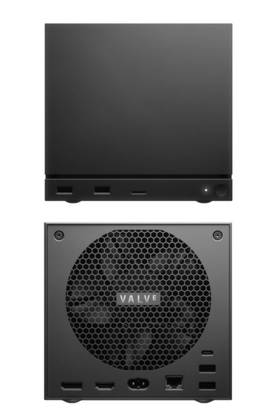
- Brand
- Valve
- Operating System
- SteamOS 3 (Arch-based)
- Processor
- Semi-custom AMD Zen 4 6C / 12T up to 4.8 GHz, 30W TDP
- Resolution
- Up to 4K @ 240Hz or 8K@60Hz
- HDR Support
- Yes
- Memory
- 16GB DDR5 + 8GB GDDR6 VRAM
Your Steam Library in more places.
With over six times the horsepower of Steam Deck, Steam Machine has the power to play your whole Steam library, including your favorite AAA titles. Just sign in with your Steam account and your entire library is there.
Core features that define Steam Machine:
SteamOS - An OS optimized for gaming, with fast suspend/resume, and cloud saves. And that's just the start.
Small form factor - Put it under your TV. Set it on your desk. Hide it under a banana. It's powerful PC gaming packed into a roughly 6-inch (~160mm) cube.
Cool & quiet - Steam Machine keeps cool and runs whisper-quiet, even while running the most demanding games.
I/O for days - Ready for all the peripherals and monitors you can throw* at it: 1 Gigabit Ethernet. DisplayPort 1.4. HDMI 2.0. One USB-C and four USB-A ports.
*But, like, don't actually throw things at it.
CPU & GPU - 4K gaming at 60 FPS with FSR, thanks to a discrete semi-custom AMD desktop class CPU and GPU.
Storage - Available in two storage sizes: 512GB and 2TB. Both come with expandable storage via microSD.
Connectivity - 2x2 Wi-Fi 6E, plus Bluetooth 5.3 with a dedicated antenna. Steam Controller's wireless adapter is built right into Steam Machine for direct pairing.
Power - No giant brick! Steam Machine's power supply is built right in.
- Storage
- 512 GB / 2TB NVMe SSD, expandable microSD
- Wi-Fi
- 2x2 Wi-Fi 6E
- Bluetooth
- Bluetooth 5.3 dedicated antenna
- Ports
- DisplayPort 1.4 / HDMI 2.0 / 2x USB-A 3.2 Gen 1 / 2x USB-A 2.0 / 1x USB-C 3.2 Gen 2 / Gigabit Ethernet / microSD / AC power
- Dimensions
- 152 x 162.4 x 156 mm
- Weight
- 2.6 kg
- VR Support
- Yes
- App Store
- Steam