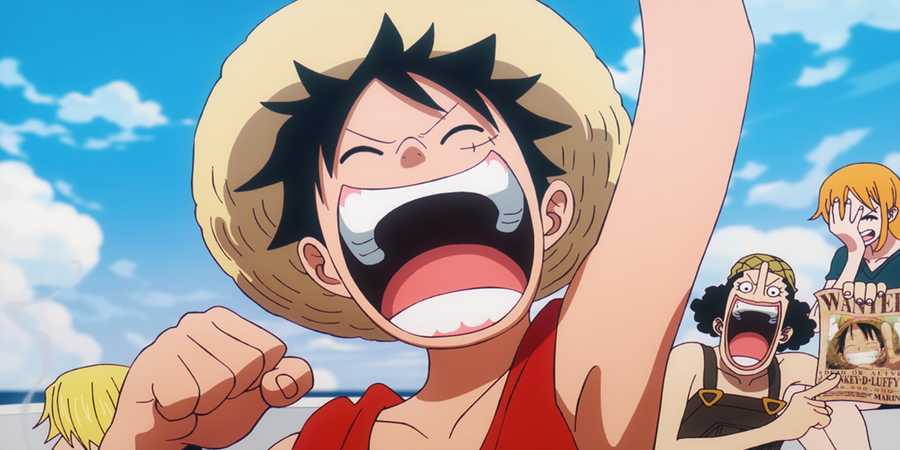
While One Piece has been very successful from the get-go, it would be nowhere near as popular as it is today if it weren’t for Toei Animation’s iconic animated adaptation. It first aired back in 1999, just two years after the manga had begun its serialization, and it quickly became one of the biggest action shōnen anime in the entire world.
However, as it’s expected from old-school adaptations like this one, it’s not entirely one-to-one, because Toei has changed many things about it that anime-only fans may not be aware of. There are a surprising number of differences between the One Piece manga and the One Piece anime, but the following eight are the absolute biggest ones so far.
Luffy’s Backstory
The Anime Skipped Luffy’s Introductory Scene
After the short prologue that details Gol D. Roger’s execution and the dawn of the Golden Age of Piracy, the story of One Piece in the manga starts with a scene that introduces its main character: a young Monkey D. Luffy can be seen stabbing his own eye with a knife in order to prove to the Red Hair Pirates that he was tough enough to be a pirate. (And yes, this is the explanation behind his iconic eye scar).
Despite the fact that this is literally Luffy’s introduction, the anime adaptation completely skipped it. As a matter of fact, Luffy’s entire backstory was moved on to Episode 4, while it was in the first chapter of the manga. Furthermore, the scene of a 17-year-old Luffy setting sail from Foosha Village and defeating the Lord of the Coast was also omitted. Both of these crucial moments wouldn’t be shown in the anime until many years later, in future arcs like the Post-War Arc and in TV specials like Episode of East Blue.
Nami’s Introduction
She Was The First Straw Hat To Appear In The Anime
As previously mentioned, Monkey D. Luffy was the first member of the Straw Hat Pirates to appear in the manga but, since the anime decided to postpone his backstory until much later, the show kicks off with Koby and Alvida’s story instead. However, the first episode also added a new scene of the Alvida Pirates pillaging a cruise ship in which Nami was looking for treasure.
Because of this odd addition, Nami makes her debut in Episode 1, which means that she’s technically the first Straw Hat to appear on-screen in the anime. On the other hand, she first appeared in the manga during the Orange Town Arc, where she could be seen running from some of Buggy’s henchmen shortly before meeting Luffy in the titular Orange Town.
The Reason Why Zeff Is Missing His Right Leg
Unnecessary Censorship Ruined A Powerful Moment
Sanji’s mentor and father figure, Zeff, is missing his right leg and has to wear a wooden peg leg in its place. It is explained how and why this happened in a flashback, but the circumstances of his limb loss differ greatly in each version of the story. In the anime, Zeff’s right leg gets caught in some underwater debris, so he is forced to cut it off quickly in order to free himself and save a drowning Sanji.
But this was completely different in the original manga: After spending 70 days stranded on a small rock island, Sanji not only discovers that Zeff had given him all the food they had, but that he was forced to eat his own right leg in order to survive. This was apparently changed because it was deemed too shocking for anime viewers, but it also completely ruined the meaning behind Zeff’s sacrifice, which not only is incredibly powerful in itself, but it also shaped Sanji’s ideals about the importance of food and sustenance.
The Long Ring Long Land Arc
The Davy Back Fight Was Extended And Aokiji Was Introduced Later
The Long Ring Long Land Arc is definitely one of One Piece’s most polarizing arcs, but it’s worth pointing out that its mixed reception was mostly caused by its anime adaptation. In the original manga, the Davy Back Fight between the Straw Hat Pirates and the Foxy Pirates is only made up of three different games – meaning that it never overstays its welcome – and the arc concludes with the shocking introduction of Admiral Aokiji.
But the anime extended the Davy Back Fight by adding three additional games that are nowhere near as funny or entertaining as the original ones and make the arc feel way longer than it needs to be. To make things even worse, the anime’s version of the Long Ring Long Land Arc doesn’t even end with Aokiji’s introduction, seeing as it was relegated to a filler arc that takes place a few episodes later.
Kaido Vs. Luffy
Kaido Originally Defeated Luffy In Seconds
Truth be told, the Long Ring Long Land Arc was the last time that Toei Animation made significant changes to an arc’s structure. After that, the studio adapted the rest of the story in a relatively faithful way, although most fans criticized it for its extended scenes and slow pacing. This culminated many years later, in the initial fight between Luffy and Kaido in Act 1 of the Wano Country Arc.
In the original manga, this encounter lasts for only a couple of panels, as Kaido defeats Luffy with just one quick but effective Raimei Hakke, which showcased how incredibly powerful he was and how vast the power gap between them truly was. However, the anime unnecessarily extended their battle by having Luffy unleash even more attacks on him for a couple of minutes, which made it seem like Kaido was struggling to fight back and completely undermined the impressive display of strength that cemented him as a terrifying antagonist in the manga.
Carrot’s Farewell
The Anime Fixed One Of The Manga’s Most Egregious Omissions
Not every single thing that the anime added and/or changed is necessarily bad, because there have been a few instances in which this adaptation actually elevated its source material and rectified some of its most controversial mistakes. For example, fans have been criticizing the conclusion of the Wano Country Arc for years, as it feels weirdly rushed, with no room left to rest before the story quickly moves on to the next arc and this had a negative effect on beloved characters like Carrot.
Despite the fact that she traveled with the Straw Hat Pirates for many days and basically became a secondary character during the Whole Cake Island Arc, she was named the ruler of Zou after Kaido's defeat and she never got to say goodbye to Luffy and the others before their departure. The anime fixed this by airing an entire filler episode (#1084) centered on the Straw Hats saying farewell to their allies at the end of the Wano Country Arc. This obviously included Carrot herself, who got to star in a captivating and emotional final scene alongside her close friends, and it was very satisfying for fans, especially those who read the manga.
Censorship
A Lot Of Violence And Obscenity Was Omitted From The Anime
Due to restrictions related to television guidelines, anime adaptations usually have to censor a lot of stuff and One Piece is no exception. The original manga is a lot more violent and gruesome than the anime, with one of the most well-known instances of censorship being Whitebeard’s fight against Akainu during the Marineford Arc: while the anime depicts the Admiral burning his mustache off with his magma, he actually destroyed the left half of his face in one of the manga’s most gruesome panels.
Many instances of visual obscenity were also censored in the anime, like when Law showed his middle finger to Kid in the human auction house back in the Sabaody Archipelago Arc. Curiously enough, this hasn’t changed at all in recent years, because the Egghead Arc featured a scene of a young Bonney showing her middle finger to some boys, but this was censored in the anime as well.
Cover Stories
The Anime Is Missing One Of The Manga’s Most Brilliant Elements
There are many ways in which Eiichiro Oda has revolutionized the manga industry, but one of the most notorious ones is his implementation of Cover Stories. These are basically short, dialogue-less, stories that are told on a weekly basis, on the first page of each new chapter. Needless to say, they are a brilliant way of showcasing what’s going on in the One Piece world when the Straw Hats are not around, not to mention that they have actually affected the main story on many occasions.
Toei tried to adapt the first two cover stories - Buggy's Crew Adventure Chronicles and Diary of Koby-Meppo - back in the early 2000s, but they stopped shortly after, with many fans theorizing that episodes that didn’t feature Luffy and his crew suffered from low ratings. This is a real shame, because it means anime-only fans have no idea what happened to Enel, Bon Clay, Bege, Yamato and many other beloved characters after their introductory arcs, and they’re definitely missing out.

One Piece
Display card tags widget Display card community and brand rating widget Display card main info widget- Release Date
- October 20, 1999
- Network
- Fuji TV
Cast
-
 Mayumi TanakaMonkey D. Luffy (voice)
 -
Kazuya NakaiRoronoa Zoro (voice)



WHERE TO WATCH