


Summary
- The Steam Deck's latest SteamOS 3.6.19 firmware update has been released.
- SteamOS 3.6.19 includes several additions and fixes that enhance the Steam Deck's battery life, graphics drivers, display colors (LCD model), and overall system performance.
- Valve has also addressed stability issues surrounding the Steam Deck's microSD card support, Bluetooth connectivity, Desktop mode, and more.
Valve has released a huge firmware update for its highly popular Steam Deck handheld gaming PC. Dubbed SteamOS 3.6.19, the update brings a huge gamut of improvements to the Steam Deck, such as enhanced battery life, upgraded graphics drivers, Bluetooth optimizations, and so much more.
The Steam Deck is one of the most popular handheld gaming PCs currently available. While competing handhelds use Windows as their operating systems, the Steam Deck sets itself apart with a slick Linux-based interface (termed SteamOS) that echoes a traditional console's user experience. Many Steam Deck users laud the intuitive software, and Valve has even confirmed that it'll make SteamOS available to its competitors in the future. For now, though, the company's sole focus is Steam Deck users, who can now download SteamOS 3.6.19.

The Steam Deck is Coming to a New Region
Valve announces that the Steam Deck will be available for sale in a new region that previously had no direct access to the gaming handheld.
One of the headliners of SteamOS 3.6.19 is the new Mesa 24.1 graphics driver, which improves game performance and overall system responsiveness. The OS itself has been upgraded to a newer Arch Linux base with an upgraded Linux kernel (6.5), which enhances security, stability, and compatibility across the system. Valve has also adjusted the Steam Deck's brightness uniformity and color balance in the display settings, which should result in a more visually pleasing image output, particularly in low-light conditions.
Most Notable Additions in Steam Deck's SteamOS 3.6.19 Update
General
-
Updated to a more recent Arch Linux base, and updated Linux kernel to version 6.5
- These updates improve hardware compatibility, system performance, security, and overall system stability
- Improved speed of subsequent OS updates
- Improved reliability of certain microSD card usage scenarios
- Worked around misdetection of some SanDisk microSD cards
- Fixed some connectivity failures with access points supporting WPA3 security
- Fixed a problem where Steam Deck would be unable to connect to certain Wi-Fi 7 access points
Graphics and Performance
- Updated graphics driver to Mesa 24.1, with many performance and other improvements
- Improved responsiveness of the Steam UI
- Improved performance and stability in memory pressure situations
- Slightly improved cold boot time
Display
- Improved display uniformity, under some conditions (Mura Compensation)
- Improved display color balance (reduced green tint) at lower brightness levels, under some conditions
- Improved gamma uniformity (yellow tint), under some conditions
- Fixed an issue where the internal display could remain blank after disconnecting an external display
External Display
- Fixed several issues where an external display could remain blank after resuming
- Fixed an issue where the system could crash on wakeup if an external DisplayPort monitor was connected
- Fixed a system crash when hotplugging a second display in Desktop mode
Bluetooth
- Improved Bluetooth pairing experience with Apple AirPods
- Enabled support for Bluetooth HFP and BAP profiles
- Added mechanism to configure which Bluetooth device categories are allowed to wake the system from suspend
- Improved connection speed of some Bluetooth devices
Desktop Mode
- Updated to KDE Plasma 5.27.10
- Fixed an issue with desktop use that could cause subsequent microSD card auto-mount to fail
Battery Life
-
Steam Deck OLED only
- Added support for the Windows Bluetooth driver (LCD models already have Windows Bluetooth support)
-
Steam Deck LCD only
- Improved battery life by up to 10% in light load situations
- Added overclocking controls
Battery life improvements are another noteworthy addition in SteamOS 3.6.19. Thanks to a fix for a memory leak, Steam Deck OLED users should notice better battery life while gaming, while Steam Deck LCD users will see around a 10% uplift in battery performance under "light load" conditions. This is ideal for low-demand tasks like downloading games, which should now be less of a drain on the Steam Deck's battery. Additionally, Steam Deck LCD users can now access overclocking controls in the BIOS, a feature previously exclusive to OLED models.
Valve has resolved a bevy of stability issues as well, such as a black screen bug that occurred when switching between the Steam Deck's Desktop Mode and Game Mode. Reliability issues for microSD cards have also been addressed, reducing the likelihood of problems when using certain SanDisk cards. The official patch notes for SteamOS 3.6.19 cover the rest of the update's additions and fixes, so those interested should definitely check out the list.
Even though the Steam Deck may not be the most powerful handheld gaming PC out there, many believe that Valve's exceptionally strong software support makes up for the deficit. With the Steam Deck heading into its third year, though, buzz around a potential successor has begun to spread. Valve even confirmed plans for a Steam Deck 2 recently, but the company isn't interested in rushing the successor's development whatsoever and is waiting for a "generational" leap in performance without sacrificing battery life.
- Brand
- Steam (Valve)
- Operating System
- SteamOS 3 (Arch-based)
- Storage
- 64GB eMMC / 256GB NVMe SSD / 512GB NVMe SSD / 1TB NVMe SSD
- VR Support
- Technically possible, but not designed or optimized for it.
- Resolution
- 1200 x 800
- App Store
- Steam
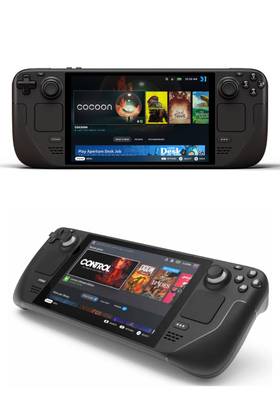
The Steam Deck is Valve's entry into the handheld PC market, using a custom Linux-based OS to bring your Steam library wherever you go. Launched in 2022 with an LCD screen, an updated model with an OLED screen followed in late 2023.
Checkbox: control the expandable behavior of the extra info- Wi-Fi
- Tri-band Wi-Fi 6E radio, 2.4GHz, 5GHz, and 6GHz 2 x 2 MIMO, IEEE 802.11a/b/g/n/ac/ax
- Ports
- USB-C with Power Delivery/DisplayPort
- HDR Support
- No
- Original Release Date
- February 25, 2022
- Original MSRP (USD)
- $399–$649
- Weight
- Approx. 640 grams
- Dimensions
- 298mm x 117mm x 49mm
- Processor
- Zen 2 4c/8t, 2.4-3.5GHz (up to 448 GFlops FP32)