


Summary
- Spirited Away intricately weaves Japanese folklore, Shinto beliefs, and universal themes into a visually stunning masterpiece.
- The film follows Chihiro's journey through a mystical realm, exploring themes of self-development, identity, and environmentalism.
- Through complex characters and symbolic imagery, Spirited Away invites viewers to delve deeper into myth and tradition.
Spirited Away is not only a visually stunning piece of animation but also a deeply symbolic narrative that draws heavily on Japanese folklore, Shinto beliefs, and other mythological traditions. Hayao Miyazaki's masterpiece, Spirited Away, was released in 2001 by Studio Ghibli and tells the story of a young girl named Chihiro who becomes trapped in a magical realm filled with spirits, gods, and other fantastical beings. Spirited Away's legacy is unrivaled, being IMDB's highest rated anime feature of all time, the film's blend of modernity and tradition, alongside its richly detailed world, has captivated audiences worldwide, leading many to explore the deeper meanings behind its characters and themes.
Spirited Away (originally titled "Sen to Chihiro no Kamikakushi") follows the tale of Chihiro Ogino, a ten-year-old girl. While relocating homes, Chihiro and her parents come across what appears to be an abandoned amusement facility. Unbeknownst to them, they have entered a realm filled with spirits. Chihiro's parents are transformed into pigs after consuming godfood, leaving her alone and terrified in this strange world. Chihiro navigates the spirit world with the help of Haku, a mysterious boy who can transform into a dragon, and works at a bathhouse run by the formidable witch Yubaba, all while hoping to save her parents and return to the human world.
Contextual Narrative Exploration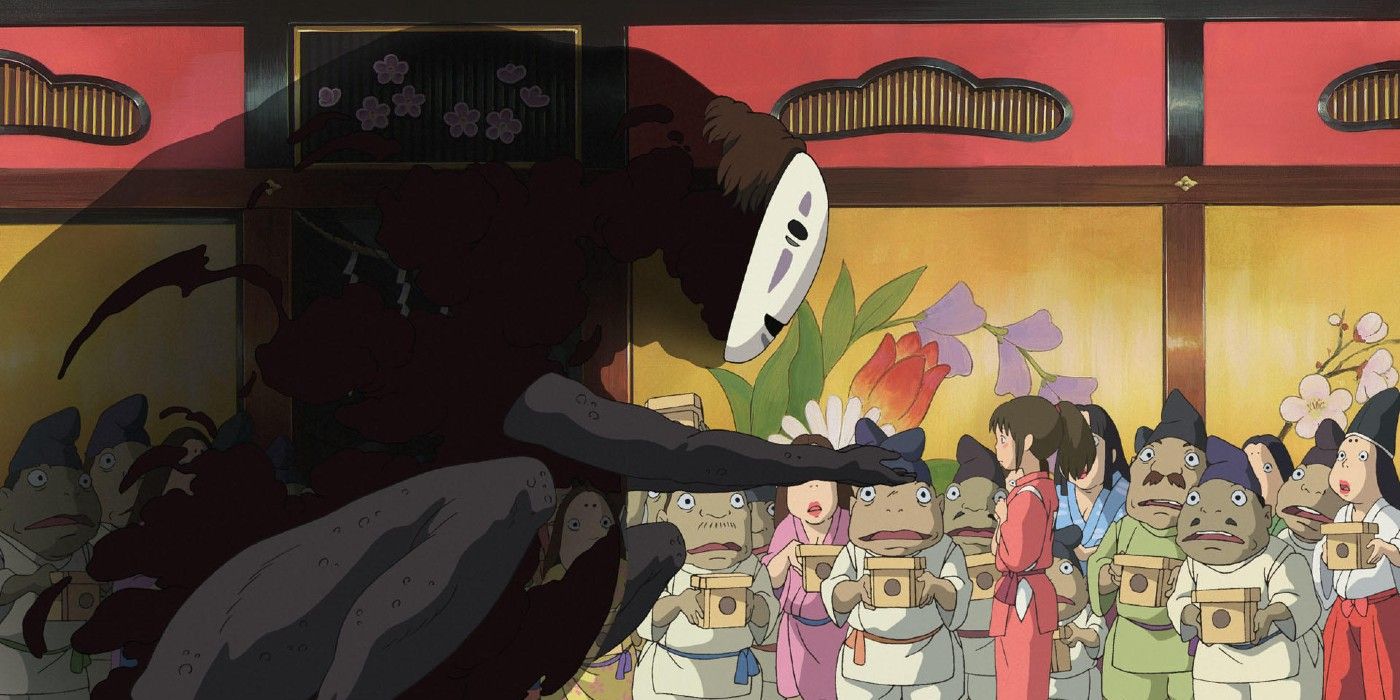
At its core, Spirited Away is a coming-of-age story. However, it is also a narrative deeply embedded in Japanese culture and spirituality. The title itself, "Sen to Chihiro no Kamikakushi," refers to the traditional Japanese concept of "kamikakushi," or "hidden by gods," where individuals, particularly children, are spirited away by supernatural forces. This notion is prevalent in Japanese folklore, often explaining the mysterious disappearances of people.
Fundamentally, Spirited Away is a coming-of-age story, a journey of Chihiro's self-development and intrinsic transcendence into maturity. Nevertheless, this centralized theme is conveyed in relation to deeply rooted Japanese traditions and spirituality. The title, "Sen to Chihiro no Kamikakushi," pertains to the traditional Japanese concept of "kamikakushi" a verb in Japanese, to be "spirited away"; taken away by the gods. Furthermore, "Kamikakushi" usually happens to children, whereby they are led away by divine entities. This concept is common in Japanese folklore, and it is frequently used to explain mysterious disappearances.
Therefore, Miyazaki's film can be considered a modern take on this traditional coming-of-age concept, integrating contemporary settings with enduring mythological themes. The abandoned amusement park that Chihiro and her parents discover serves as a transitional space, a link between the real world and the fantastical world of the "kami" and spirits. The concept of a threshold, or a place between worlds, is a common theme in mythologies around the world, illustrating a point of transition and transformation.
Shintoism: The Spiritual Backbone of "Spirited Away"

Shintoism, Japan's native theology, plays an important role in the mythological foundations of Spirited Away. Shinto, translated as "way of the gods", is a religion that worships "kami", spirits or deities associated with elements of nature, predecessors, and other aspects of natural life. Unlike the Western religions of Classical Theism, Shinto does not have a founder, sacred scriptures, or an omnipotent, monotheistic deity. Instead, it is a set of beliefs and rituals that honor the sanctity of nature and the interrelationship of all living things.
The world of Spirited Away is populated by numerous kami, each reflecting a different aspect of Shinto beliefs. The bathhouse, where much of the story takes place, serves as a shelter for the Kami to cleanse themselves of abstractions, in line with Shinto practices of cleanliness and purification. The various spirits Chihiro encounters, spanning from river gods to soot sprites, are all based on the Shinto belief that every element of nature has a spiritual essence.

Why Didn’t Hayao Miyazaki Pick Up His Oscar for The Boy and the Heron?
Hayao Miyazaki raised some eyebrows when he didn't appear to accept his Oscar for The Boy and the Heron. What went into his decision not to show?
Characterial Inspiration, Symbolism and Origin
The characters in Spirited Away are profoundly associated with various aspects of mythology and serve as embodiments or symbols of folklore. Each character represents various aspects of spiritual and cultural significance, resulting in an intricate web of symbolic meaning.
Chihiro/Sen

Chihiro, who becomes Sen in the spirit world, represents innocence and the journey towards maturity. Her transformation from a whiny, reluctant child to a brave, resourceful young girl mirrors the traditional "hero's journey" in mythology, where the protagonist undergoes trials and emerges transformed.
The hero's journey, also known as the monomyth, is a narrative template that depicts a hero embarking on an adventure, confronting and overcoming a crisis, and returning transformed, usually internally, with a developed sense of "self". Joseph Campbell popularized this concept with his seminal work, "The Hero with a Thousand Faces" (1949). Campbell discovered common patterns in myths from various cultures, implying that they all share a basic structure.
Chihiro's journey in Spirited Awa y corresponds closely to the stages of the hero's journey. She begins in the ordinary world. However, there is a shift that propels her out of normality. She is moving to an entirely unknown location, leaving her known life behind her, and this is the catalyst for her venture down the hero's path. She then moves on to the special world of the spirits, faces numerous trials, meets new allies, confronts the central ordeal, and eventually returns to the ordinary world transformed. This narrative structure is not only central to many myths, but it also resonates strongly with audiences, reflecting universal themes such as growth, struggle, and transformation.
Yubaba's renaming of Chihiro as Sen is crucial. In Japanese culture, titles are extremely powerful, and changing one's name may symbolize a loss of identity. This is reflected in Chihiro's struggle to remember her true name, which serves as a metaphor for her struggle to maintain her identity during the turmoil of existential change. Therefore, she must overcome, develop, and be reborn as a new version of her previous self.
Haku
.jpg?q=49&fit=crop&w=500&dpr=2)
Haku is a river spirit who can transform into a dragon, drawing on Japanese folklore in which dragons are frequently depicted as water deities. His true identity as the Kohaku River connects him to Shinto beliefs, in which natural elements such as rivers and mountains are revered and inhabited by kami (gods).
Haku's submission to Yubaba and quest to reclaim his true identity parallels Chihiro's journey, emphasizing themes of memory and self-discovery. His shape-shifting ability, as well as his dual existence in both human and dragon forms, are reminiscent of traditional Japanese mythology, in which gods and spirits frequently change form.
The myth of the Sumiyoshi Sanjin, deities associated with sea travel and purification, is an appropriate Shinto tale that reflects Haku's character. These kami represent the spirit of water bodies, emphasizing the purity and life-giving properties of rivers and seas. The story of Sumiyoshi Sanjin conveys the importance of water deities in guiding and protecting those who travel over or rely on water, similar to Haku's role in guiding and protecting Chihiro.
Yubaba and Zeniba

Yubaba, the bathhouse witch, is a complex character who draws on a variety of mythological and cultural influences. Her character design, with her massive head and extravagant attire, resembles the Yamauba, a mountain witch from Japanese folklore known for her cunning and supernatural abilities.
Zeniba, Yubaba's twin sister, represents a kinder version of the same archetype. Yubaba and Zeniba represent the dual nature of many mythological figures who have both nurturing and destructive qualities. This duality also reflects the balance of opposites, a Daoist idea that is internationally recognized, "yin and yang".
Yubaba's aggressive and domineering nature represents yang, whereas Zeniba's nurturing and peaceful demeanor represents yin. This balance of opposites is critical to maintaining harmony in the film's world, reflecting Daoist beliefs about the value of balance and harmony in the universe.
Kaonashi (No-Face)

No-Face is one of the most mysterious characters in Spirited Away. He is a spirit that appears innocent at first but transforms into a monster as he absorbs the greed and desires of others. His character can be interpreted as a commentary on the dangers of unchecked desire and consumption, which are common themes in mythology and religious teachings.
The symbolism of No-Face's mask, as well as his ability to consume and mimic others, all relate to the concept of losing one's identity and the dangers of a lack of self-awareness. In some interpretations, No-Face represents the void or the unknown, which appears in many mythological traditions as a symbol of both potential and danger.
No-Face's character is reminiscent of the Japanese folklore about faceless ghosts, known as "Noppera-Bō". These spirits appear to be ordinary humans but have lost their facial features, indicating a sense of emptiness or loss of self. The Noppera-Bō scare people with their featureless faces, similar to how No-Face's transformation into a monster reflects his absorption of negative traits from his surroundings.
Spirited Away's Key Themes
Self-development, Metamorphosis and Identity

The theme of growth is the centerpiece of Spirited Away's narrative drive and nuance. Chihiro's journey is defined by physical, emotional, and spiritual transformations, which reflect the universal mythological theme of metamorphosis. Her experiences in the spirit world challenge her perceptions and force her to grow, much like the transformative journeys of the aforementioned mythological heroes.
The loss and reclaiming of identity, as seen in Chihiro's struggle to remember her name and Haku's quest to rediscover his true self, is reminiscent of many mythological stories in which characters face trials to discover their true essence. This theme is consistent with Shinto beliefs about the importance of understanding one's place and role within the natural order.
The Sin of Greed and Purification

The bathhouse where Chihiro finds unwilling employment, is a place of cleansing and renewal, based on the Shinto practice of ritual purification. The spirits who visit the bathhouse want to be purified, which represents the removal of physical and spiritual impurities. The film's critique of greed is evident in the transformation of Chihiro's parents into pigs after they consume the spirit world's food. This transformation is a direct reference to the consequences of gluttony and materialism, which are prevalent themes in both myth and religious teachings. No-Face's excessive consumption and subsequent rampage in the bathhouse highlight the destructive power of unchecked desires.
This thematic emphasis on greed and purification transcends just Japanese traditional belief, but exists in the famous Dante Alighieri's "Divine Comedy", specifically the concept of the seven deadly sins. In Dante's work, greed is one of the sins punished in Hell, where sinners are condemned to suffer for their excessive desire for material wealth. The transformation of Chihiro's parents into pigs personifies this sin, mirroring the symbol of greed in "Divine Comedy." Their gluttonous behavior in the spirit world dehumanizes them, just as the souls in Dante's Inferno face grotesque and fitting punishments for their earthly sins.
No-Face's insatiable appetite and subsequent rampage in the bathhouse highlight the destructive consequences of unbridled greed, evoking Dante's punishments for the avaricious. This parallel with Dante's depiction of greed highlights a universal critique of materialism and the moral degradation it causes, connecting Eastern and Western mythological perspectives on the corrupting power of unchecked desires.
Environmentalism

Environmental themes are subtly woven throughout Spirited Away, reflecting director Hayao Miyazaki's deep respect for nature and concerns about the impact of human activity on the planet. The film's story and characters emphasize the Shintoistic unity of all life and the importance of protecting the natural world.
One of the most poignant examples of this theme is Haku's true identity as a river spirit. In Shinto belief, kami, or spirits, inhabit natural elements such as rivers, mountains, and forests. Haku, the Kohaku River spirit, represents the life-giving and sacred nature of rivers, which are revered in Shinto as vital sources of sustenance and purity. His character emphasizes the spiritual significance of natural elements in Japanese culture.
A further significant environmental symbol in the film is the polluted river spirit, which Chihiro helps to cleanse. This character, who first appears as a "stink spirit," is revealed to be a river god plagued by pollution and debris. This transformation emphasizes the devastating consequences of environmental neglect and pollution. The cleansing of the river spirit represents environmental restoration and nature's healing power when human intervention repairs the damage.
These elements reflect Miyazaki's own environmentalist views. His creations express his ecological ideology; humans should adopt the Shinto notion of respecting the environment for the phenomena the natural world truly is. Miyazaki's depiction of the noxious impact of greed, capitalism and selfish behavior is always shown to have ramifications on the environment, Earth's most prized possession.

Hayao Miyazaki’s Son Reveals the Studio Ghibli Legend Isn’t Done Yet
For a man who said he was retired, Hayao Miyazaki seems to have found a second wind for Studio Ghibli and isn't giving up yet. But what will he make?
Spirited Away is a rich weaving of mythology that seamlessly weaves together Japanese folklore, Shinto beliefs, Daoist principles, and universal mythological themes. Through its complex characters, transformative journeys, and symbolic imagery, the film invites viewers to delve deeper into meaning and consider their own place in the world.
Miyazaki's masterful storytelling and detailed world in Spirited Away serve as a compelling reminder of the power of myth and the timeless human quest for understanding and connection. The film's enduring appeal stems not only from its stunning visuals, but also from its deep engagement with the myths and traditions that continue to shape our collective imagination.

Spirited Away
Display card tags widget Display card community and brand rating widget Display card main info widget- Release Date
- July 20, 2001

WHERE TO WATCH
- Runtime
- 125 minutes
- Director
- Hayao Miyazaki
- Studio
- Studio Ghibli
